Why Is My Husband Giving Me Silent Treatment? How to Recognize Unspoken Needs in a Husband

How to Recognize Unspoken Needs in Your Husband
If your husband seems distant, quiet, or emotionally unavailable, his behavior may be expressing needs he does not know how to say out loud. In many marriages, men show stress, disconnection, and unmet emotional needs through withdrawal, irritability, overworking, distraction, or fading affection instead of direct conversation.
You ask him if he is okay. He says yes, but something still feels off.
He is not starting a fight. He is not telling you he wants out. He is simply harder to reach than he used to be, and now you are left carrying the emotional weight of trying to figure out what changed. You replay conversations, question yourself, and wonder whether to ask again or give him space.
For women in committed relationships between 30 and 55, this kind of disconnection can feel especially painful. You may share a home, a history, routines, responsibilities, and years of life together, yet still feel emotionally alone in the relationship. That is what makes this dynamic so exhausting. It is subtle enough to be hard to explain, but painful enough to change the emotional tone of everyday life.
The good news is that distance is not always indifference. Sometimes it is stress. Sometimes it is emotional overload. Sometimes it is a husband struggling to process feelings he was never taught how to name. When you understand what his behavior may be signaling, you can respond with more clarity, protect your own emotional well-being, and create better conditions for reconnection.
If you are feeling alone in your marriage and want structured help understanding what your husband may not be saying, explore this relationship support resource 💛
Article Navigation
This article by understandingman.com explains why husbands pull away, go quiet, seem emotionally unavailable, stop showing affection, or ask for space, and what those changes may actually mean. It also shows how to respond in a way that creates emotional safety, improves communication, and increases the chance of reconnecting.
- Why Does My Husband Show His Needs Indirectly Instead of Talking About Them?
- What Does Emotional Withdrawal Mean in a Marriage?
- Why Does My Husband Go Quiet at the End of the Day?
- What Does It Mean When My Husband Pulls Back Emotionally or Physically?
- Why Does My Husband Seem Present but Emotionally Unavailable?
- Why Is My Husband Irritable When Something Else Is Going On?
- Why Does My Husband Suddenly Want More Space?
- What Does My Husband’s Physical Tension Reveal?
- Why Does My Husband Throw Himself Into Work, Hobbies, or Projects?
- Why Does My Husband Try to Solve Problems Instead of Connecting Emotionally?
- What Does It Mean When Affection Starts to Fade in Marriage?
- How Do I Ask My Husband What He Needs Without Pushing Him Away?
- How Do I Rebuild Emotional Safety in My Marriage?
- What Changes When I Stop Chasing and Start Understanding the Pattern?
- When Is My Husband’s Distance a Signal and When Is It a Red Flag?
- What Is the Real Goal When My Husband Pulls Away?
- FAQ
Why Does My Husband Show His Needs Indirectly Instead of Talking About Them?
Many husbands show their needs indirectly because they were taught to manage vulnerability privately and stay in control. Instead of saying they feel hurt, overwhelmed, disconnected, or unappreciated, they often go quiet, get tense, or distract themselves.
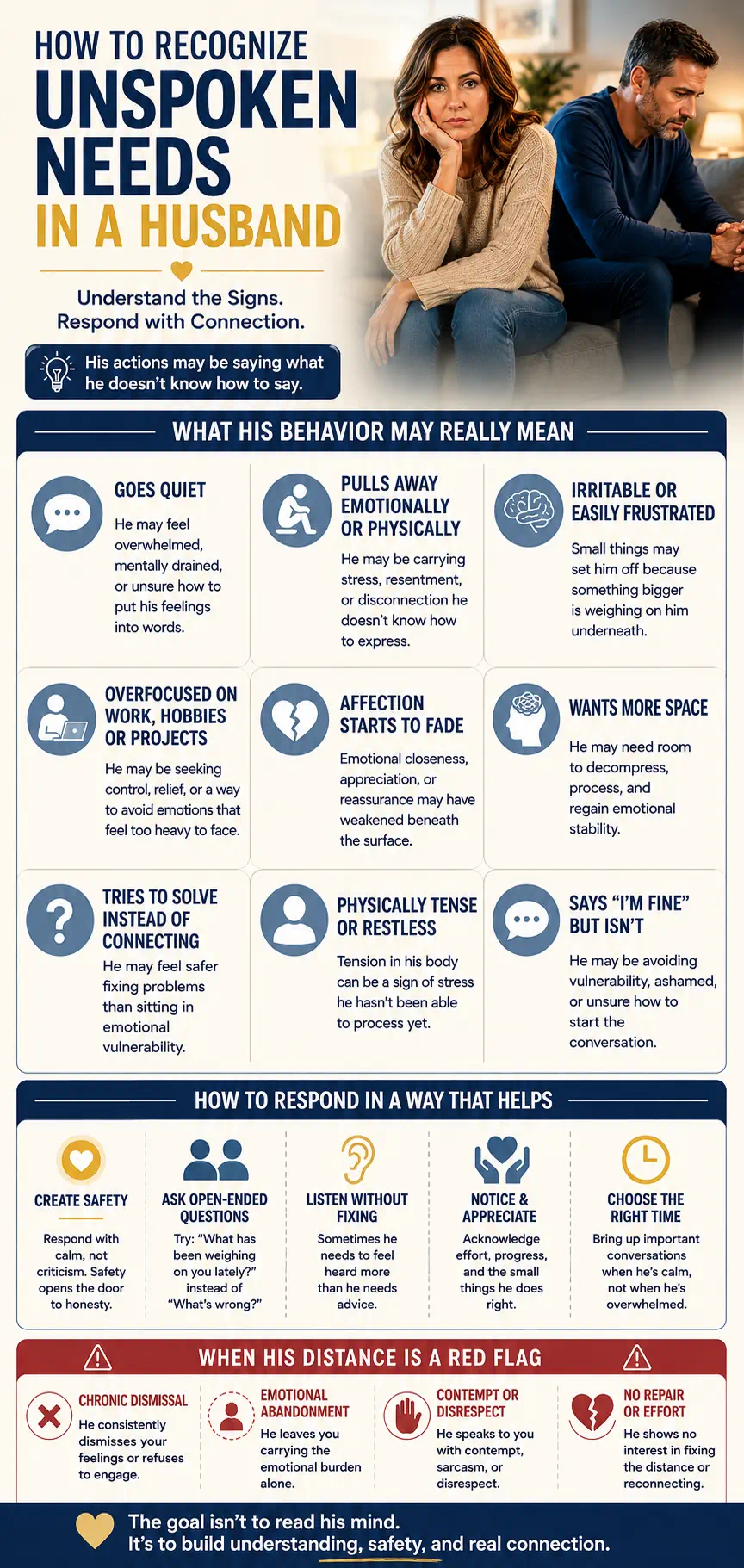
For many wives, this is one of the hardest parts of marriage. You are willing to talk. You want to understand. But he keeps saying he is fine even when his mood, tone, and distance say otherwise.
For many men, emotional restraint was learned early. They were taught not to need too much, not to ask for comfort, and not to linger in feelings they could not easily fix. Even in a loving marriage, those habits can stay in place for decades.
So instead of saying, “I feel disconnected from you,” he may become harder to reach. Instead of saying, “I feel like I can’t get it right lately,” he may become irritable. Instead of saying, “I’m overwhelmed and don’t know how to explain it,” he may bury himself in work, chores, television, hobbies, or his phone. For some men, this also overlaps with difficulty identifying and describing emotions, which can make it harder to explain what they feel even when something is clearly wrong.
What Does Emotional Withdrawal Mean in a Marriage?
Emotional withdrawal usually means your husband feels overloaded, shut down, or unable to process what he feels, not automatically that he has stopped loving you. In a marriage, withdrawal can signal stress, resentment, emotional fatigue, or unmet needs that have gone unspoken for too long.
For many wives, silence hurts more than conflict. At least conflict gives you something concrete to work with. Silence leaves you guessing and carrying the emotional burden of the marriage by yourself.
When a husband starts feeling harder to reach, it is easy to assume the worst. Maybe he is falling out of love. Maybe he is tired of the marriage. Maybe you are the only one trying.
Sometimes deeper marital issues are present. But often, withdrawal begins because he feels emotionally flooded, pressured, ashamed, or unsure how to explain what is happening inside him. He may not fully understand it himself yet, which is why reacting to every quiet moment as a threat can escalate the cycle instead of helping. In many cases, it lines up with warning signs of emotional distress and stress overload that show up in behavior before they ever show up in words.
Why Does My Husband Go Quiet at the End of the Day?
When your husband goes quiet after work or family stress, he may need time to mentally and emotionally decompress before he can reconnect. His silence is often about overload and transition, not rejection.
This pattern is common in long-term marriages because daily life is heavy. Work pressure, finances, parenting, household responsibilities, aging parents, health concerns, and constant problem-solving can drain emotional energy by the end of the day.
For many wives, evening is when connection is finally possible. The tasks slow down, and you want warmth, conversation, or simple closeness. Meanwhile, he may feel like he has nothing left to give in that moment.
That mismatch can create pain on both sides. You feel dismissed or lonely. He feels pressured when he is already running on empty. Often, it helps to see this quietness as a transition problem first. He may need a little room to land before he can be emotionally present again.
What Does It Mean When My Husband Pulls Back Emotionally or Physically?
When your husband pulls back emotionally or physically, it often means something feels unresolved, heavy, or difficult for him to express. If the distance becomes a pattern, it may point to stress, resentment, disconnection, or an unmet emotional need in the marriage.
This can show up as less eye contact, shorter answers, flatter tone, less affection, less curiosity about your day, or the feeling that he is there but not truly with you. Many wives notice these shifts quickly, even before there is an obvious reason.
In marriage, this kind of distance can feel deeply painful because it touches your history together. You remember when he was more engaged, affectionate, playful, or emotionally available. The contrast is what hurts.
Your instinct to notice that shift matters. You do not need to dismiss your experience just because he has not explained it yet. At the same time, it helps not to overread one isolated moment. A repeated pattern is what deserves your attention.
Why Does My Husband Seem Present but Emotionally Unavailable?
When your husband seems physically present but emotionally absent, he may be carrying stress, relational tension, or inner confusion that he has not shared. Emotional unavailability often looks like distraction, surface-level conversation, and a lack of real emotional engagement.
This is one of the loneliest experiences inside a marriage. You can sit next to the man you love and still feel completely alone.
He may nod while you speak but not really respond. He may give practical answers without emotional presence. He may scroll, joke, or change the subject whenever things start to feel personal. Over time, this creates a quiet ache because the marriage still functions on the surface while the connection underneath feels thinner.
Sometimes he is avoiding the conversation because he does not know what he feels. Sometimes he fears disappointing you. Sometimes he senses the distance between you and does not know how to step into it without making it worse.
Why Is My Husband Irritable When Something Else Is Going On?
Irritability often appears when a husband is carrying emotional discomfort he has not named directly. A sharp reaction to something small may be a sign that something bigger is building underneath the surface.
Many wives immediately turn inward when their husband becomes short-tempered. You may wonder whether you said something wrong, whether he is angry with you, or whether the marriage is more fragile than it looks.
But the small issue is often not the real issue. He may already feel criticized, overlooked, overwhelmed, pressured, or emotionally disconnected. Instead of saying that clearly, the tension leaks out through impatience, defensiveness, or a short fuse.
This does not excuse harsh behavior. Repeated meanness, contempt, or volatility should not be normalized. But understanding that irritability often points to something deeper can help you respond with more steadiness and less self-blame.
Why Does My Husband Suddenly Want More Space?
A sudden need for space does not always mean your husband wants less marriage. Often, it means he is trying to lower internal pressure so he can feel more emotionally stable again.
This is especially confusing for wives who reconnect through talking, closeness, and time together. When you feel distance, your instinct may be to lean in. When he feels strained, his instinct may be to step back.
That creates a painful cycle. The more alone you feel, the more you reach for clarity and reassurance. The more pressured he feels, the more he retreats. Neither of you feels safer, and the gap grows.
Sometimes space is avoidance. But sometimes it is his attempt to calm himself enough to come back. The important question is what happens after the space. Does he return warmer, more open, and more available, or does the distance keep expanding?
What Does My Husband’s Physical Tension Reveal?
Physical restlessness like pacing, jaw-clenching, tension, fidgeting, or agitation can signal emotional stress before he has words for it. The body often reveals pressure that the mind has not fully processed yet.
Many wives notice this early. You can see that he is tense even while he insists nothing is wrong. You notice it in how quickly he reacts, how uncomfortable he seems, or how hard it is for him to settle.
That mismatch can make you question your instincts. But your read may be accurate. He may truly not know how to explain what is happening yet, even though it is already affecting his body and behavior.
If he seems physically unsettled, treat it as useful information. Something may be weighing on him, and patience will usually get you further than pressing him too hard in the moment.
Why Does My Husband Throw Himself Into Work, Hobbies, or Projects?
When a husband suddenly becomes deeply absorbed in work, hobbies, or projects, he may be trying to regain control, competence, or relief from emotional discomfort. Productivity often feels safer than vulnerability.
In marriage, this can be easy to rationalize. He is working hard. He is getting things done. He is being productive. From the outside, it may even look admirable.
But sometimes constant doing is a form of emotional hiding. When marriage tension builds or emotional closeness feels difficult, work and projects can offer something the relationship currently does not: clarity, measurable progress, and a sense of success.
That does not automatically mean he is withdrawing on purpose. But it can mean he is moving toward the place where he still feels effective and sure of himself.
Why Does My Husband Try to Solve Problems Instead of Connecting Emotionally?
When your husband responds with solutions instead of empathy, he may be trying to help in the way that feels safest and most familiar to him. Problem-solving is often easier for men than staying in emotionally vulnerable conversation.
This is one of the most common frustrations wives describe. You open up because you want comfort, understanding, or closeness. He responds with advice, next steps, or a practical fix.
That can feel deeply invalidating when what you really needed was to feel emotionally met. But often, he is not trying to dismiss you. He is trying to stay useful without stepping into emotional territory that feels harder for him to navigate.
Fixing feels clear. Feelings do not. When you understand that, it becomes easier to guide the conversation more directly instead of assuming he does not care.
What Does It Mean When Affection Starts to Fade in Marriage?
When affection quietly fades in a marriage, it can signal that emotional connection, reassurance, appreciation, or relational safety has weakened beneath the surface. Loss of warmth is often one of the first visible signs of deeper disconnection.
This is painful because it rarely happens all at once. There is no single dramatic moment. He just becomes less affectionate, less playful, less physically warm, and less likely to reach for you first.
Many wives notice this shift long before they say anything out loud. You may wonder whether you are being too sensitive or reading too much into it. Usually, you are noticing something real.
In marriage, affection is not just romance. It is reassurance. It is belonging. It is one of the daily ways love stays visible. When it fades, the loss can feel deeper than it looks from the outside.
How Do I Ask My Husband What He Needs Without Pushing Him Away?
The best way to ask what your husband needs is through calm, open-ended conversation at a time when he does not feel cornered, criticized, or emotionally ambushed. Men are more likely to open up when the conversation feels safe instead of pressurized.
For wives who have been carrying the emotional weight of the marriage, it is tempting to bring it up the moment the pain becomes too much. You feel lonely, confused, and tired of guessing, so you ask when your hurt is strongest.
But timing matters. Tone matters. Pressure matters. If you ask while he is defensive, exhausted, or already shut down, you are more likely to get a wall than an answer. A calmer moment gives the conversation a better chance.
Questions like these often work better than “What is wrong with you?” or “Why are you acting like this?” You can ask, “What has been weighing on you lately?” or “I feel like we have been disconnected, and I want to understand what is going on.” Side-by-side conversations during a walk or car ride often feel less intense than face-to-face emotional pressure.
If you want a guided communication tool for hard conversations with your husband, this couples communication resource can help you start the conversation more calmly 🗣️
How Do I Rebuild Emotional Safety in My Marriage?
Emotional safety is rebuilt through small, repeated moments where honesty is met with calm instead of criticism and vulnerability is met with steadiness instead of pressure. Husbands usually open up more when they feel less likely to be judged, corrected, or rushed.
This matters deeply in long-term marriages because old patterns become automatic. If every hard conversation quickly turns into blame, defensiveness, or shutdown, both of you start bracing before the conversation even begins.
Reconnection rarely comes from one perfect talk. It usually grows through small changes in how you respond to each other every day. That might look like validating before explaining your side, noticing effort before pointing out what is missing, or giving him a little room to settle before bringing up something heavy.
It can also mean asking more directly for what you need instead of only reacting to what hurts. Simple responses like “That makes sense,” “I can see why that would feel heavy,” or “I appreciate you telling me that” can soften the conversation and make honesty feel safer. Research-informed relationship guidance on how emotional attunement strengthens connection in marriage reinforces why these small daily interactions matter so much over time.
Some couples also benefit from a step-by-step relationship workbook designed to rebuild trust, safety, and connection over time 📘
What Changes When I Stop Chasing and Start Understanding the Pattern?
When you stop reacting to every shift as rejection and start reading his behavior as information, the marriage often becomes less reactive and more honest. Curiosity helps break the painful cycle where he pulls away and you work harder and harder to close the distance.
Many wives know this cycle well. He gets quiet. You feel anxious and try to reconnect. He feels pressured and retreats more. You feel even more alone and begin pushing harder for answers. Before long, both of you feel misunderstood.
Once you can see the pattern, you do not have to keep repeating it. That does not mean ignoring your hurt or pretending distance does not matter. It means responding with more self-trust, more clarity, and less panic.
It also means expecting your husband to take responsibility for learning how to stay present and communicate better over time. Understanding the pattern is not the same as excusing it.
When Is My Husband’s Distance a Signal and When Is It a Red Flag?
Distance is a signal when it is temporary, understandable in context, and followed by repair. It becomes a red flag when it is chronic, dismissive, contemptuous, or leaves you carrying the emotional burden of the marriage by yourself for long periods of time.
Not every emotionally unavailable pattern is something you can decode your way out of. Sometimes the issue is temporary stress or emotional overload. Sometimes the issue is a long-standing unwillingness to communicate, repair, or show up differently.
Ask yourself what happens after the withdrawal. Does he come back and reconnect? Does he acknowledge the impact on you? Does he make any effort to help the marriage feel safer again? Or does he leave you alone with the confusion over and over?
Women in committed relationships often stay stuck too long trying to understand behavior that is no longer just confusing, but consistently painful. Understanding him matters, but so does protecting your own emotional well-being.
What Is the Real Goal When My Husband Pulls Away?
The real goal is reconnection, not mind reading. You do not need perfect insight into every mood change; you need clearer patterns, calmer responses, and more honest conversations that help both of you feel less alone in the marriage.
Much of what feels mysterious about male behavior becomes easier to understand when you stop expecting emotional truth to arrive in perfect words. Sometimes it shows up through silence, distance, irritability, overwork, or fading affection.
The goal is not to excuse every withdrawn moment or carry the whole marriage on your own. The goal is to understand what may be happening beneath the surface so you can respond with more wisdom, protect your own heart, and create better conditions for closeness to return.
For women in long-term relationships and marriages, that shift matters. When you stop blaming yourself for every change in his mood and start seeing the deeper pattern, you regain clarity. And clarity is often the first step back toward connection.
FAQ
Why Does My Husband Pull Away When Things Seem Fine?
Your husband may pull away even when things seem fine because he is feeling stress, pressure, emotional overload, or disconnection that he does not know how to explain yet. In many marriages, men withdraw before they verbalize what is wrong, so the distance is often a signal of something internal rather than proof that he has stopped caring.
This can be confusing because there may be no obvious fight or trigger. For a deeper look at this pattern, read why he pulls away when you need connection most.
Why Does My Husband Go Quiet Instead of Telling Me What Is Wrong?
Many husbands go quiet because silence feels safer than trying to explain emotions they do not fully understand or know how to express. He may be feeling overwhelmed, ashamed, pressured, or disconnected, but not have the words for it in the moment.
For wives, this can feel lonely and frustrating. But his silence is often about emotional difficulty, not emotional indifference.
Why Does My Husband Seem Emotionally Unavailable All of a Sudden?
A husband can seem emotionally unavailable all of a sudden when stress, resentment, burnout, or inner pressure starts taking up more emotional space than he knows how to manage. What feels sudden to you may have been building quietly inside him for a while.
This kind of shift matters because it often changes the tone of the whole marriage. The sooner you notice the pattern, the easier it is to address it before it hardens into deeper distance.
Is My Husband Losing Interest in Me or Just Stressed?
Your husband may be stressed rather than losing interest, especially if his distance shows up alongside work pressure, exhaustion, irritability, or emotional shutdown. The key difference is whether he eventually re-engages and shows signs of care, effort, or repair after pulling back.
Stress usually creates temporary distance with some return to connection. Loss of interest tends to feel more chronic, detached, and emotionally flat over time.
Why Does My Husband Want Space When I Am Trying to Get Closer?
Your husband may want space because closeness feels like pressure when he is already emotionally strained or overwhelmed. What helps you feel connected may feel to him like one more demand when he does not have the emotional capacity to respond well.
This does not always mean he wants less marriage. Sometimes he needs breathing room so he can come back more open and steady. If this pattern shows up most strongly after arguments, read why he pulls away after conflict and how to reconnect with your husband.
Why Does My Husband Get Irritated Over Small Things?
Your husband may get irritated over small things because the small thing is not really the main issue. Irritability often happens when he is carrying emotional discomfort, stress, or resentment that has not been named directly.
That does not make hurtful behavior okay. But it does explain why his reaction may seem bigger than the situation in front of you.
Why Has My Husband Stopped Being Affectionate?
A husband often becomes less affectionate when emotional closeness, appreciation, reassurance, or relational safety has weakened beneath the surface. In many marriages, affection fades quietly before a husband can clearly explain why he feels off.
This can feel especially painful because affection is not just physical. It is often one of the daily ways love, warmth, and reassurance stay visible in a long-term relationship.
Why Does My Husband Focus on Work or Hobbies Instead of Connecting With Me?
Your husband may focus on work or hobbies because those spaces feel more manageable, productive, and emotionally safe than vulnerable relationship conversations. When he feels confused, pressured, or disconnected, doing something measurable can feel easier than talking about what he feels.
This does not automatically mean he is choosing those things over you. Often, he is moving toward the places where he still feels competent and in control.
Why Does My Husband Try to Fix Everything Instead of Listening to Me?
Your husband may try to fix everything because problem-solving feels safer and more familiar than emotional vulnerability. Many men respond with solutions when they care but do not know how to stay fully present in feelings.
This can feel invalidating when you want empathy, not advice. But his fixing is often an attempt to help, even when it misses what you actually need.
How Do I Talk to My Husband Without Making Him Shut Down?
The best way to talk to your husband without making him shut down is to choose a calm moment, use open-ended questions, and keep your tone warm instead of pressuring. Men are more likely to open up when they do not feel cornered, criticized, or forced to explain themselves instantly.
Timing matters as much as wording. A gentle conversation during a walk, drive, or quiet moment often works better than an intense talk during conflict.
What Should I Say When My Husband Says Nothing Is Wrong but Feels Distant?
When your husband says nothing is wrong but feels distant, say something simple that notices the change without accusing him. A line like, “I feel like something has been off, and I want to understand, not assume,” creates more safety than pushing for an immediate explanation.
This approach matters because it lowers defensiveness. It lets him know you are paying attention without turning the moment into a confrontation.
How Can I Reconnect With My Husband When We Feel Emotionally Distant?
You can reconnect with your husband by reducing pressure, noticing patterns, creating calmer conversations, and rebuilding emotional safety in small daily ways. Reconnection usually happens through steady moments of warmth, validation, and honesty rather than one big breakthrough talk.
That means looking for repeated opportunities to soften the dynamic. It also means asking clearly for what you need while making room for him to open up at a pace he can handle. If you are trying to repair a marriage that already feels strained, read 10 proven strategies to save your marriage even when he does not want to.
If you want extra support beyond this article, this marriage reconnection program offers practical steps for rebuilding closeness and communication ❤️
How Do I Know if My Husband Needs Support or if This Is a Red Flag?
You can tell your husband needs support when his distance seems temporary, tied to stress, and followed by repair, effort, or reconnection. It becomes a red flag when the distance is chronic, dismissive, contemptuous, or leaves you carrying the emotional burden of the marriage alone for long stretches.
This distinction is important. Understanding him should never require abandoning your own emotional well-being.
Am I Overreacting for Feeling Hurt When My Husband Pulls Away?
You are not overreacting for feeling hurt when your husband pulls away because distance inside a committed relationship naturally affects emotional security and connection. Feeling confused, lonely, or unsettled when your husband becomes hard to reach is a valid response.
Your feelings are important data, not a weakness. The goal is to respond to that hurt with clarity instead of panic or self-blame.
Can a Marriage Recover From Emotional Disconnection?
Yes, a marriage can recover from emotional disconnection if both people are willing to notice the pattern, talk more honestly, and rebuild trust and safety over time. Many couples reconnect when they stop reacting defensively and start understanding what is happening underneath the withdrawal.
Recovery does not usually happen all at once. It happens through repeated moments of repair, responsibility, and better emotional habits.
Many couples also use structured relationship courses or counseling-based tools to support the repair process, and this guided relationship recovery tool is worth exploring if you want guided help 🛠️
When Should I Stop Trying to Decode His Behavior and Ask for Real Change?
You should stop trying to decode his behavior alone when the pattern is ongoing, painful, and not followed by effort, accountability, or repair from him. Understanding your husband can help, but a healthy marriage still requires him to participate in communication and reconnection too.
This matters because insight is not the same as change. You should not be left doing all the emotional work by yourself.


Comments
Post a Comment