Why Is He Pulling Away Emotionally?
How to Understand a Man’s Emotional Needs Without Pushing Him Away

You feel the distance before he says a word.
He gets quieter. You get more careful. You try to connect, ask what is wrong, or reach for reassurance, and somehow he seems even farther away. If that pattern keeps happening, it can leave you feeling confused, lonely, and emotionally exhausted.
If you have been trying harder and getting less in return, the problem may not be that you care too much. The problem may be that you are trying to create closeness in a way that feels urgent to you but overwhelming to him.
This article will help you understand a man’s emotional needs, recognize the difference between space and withdrawal, and respond in a way that builds connection without losing yourself in the process.
If you are exhausted from second-guessing every conversation and want a clearer roadmap for what men need emotionally, start with something simple and clarifying.
💛 Click Here to Take the Devotion Quiz
Article Navigation
This article by understandingman.com explains why men often pull away under emotional pressure, what they usually need to feel safe, and how to respond without pushing them farther away. It also shows you how to tell the difference between healthy space and emotional unavailability, what to say in hard moments, and how to build lasting emotional connection.
- Why Does He Pull Away When You Try to Get Closer?
- What Hurts So Much When a Man Shuts Down Emotionally?
- What Emotional Needs Do Men Have in a Relationship?
- How Can You Tell Whether He Needs Space or Support?
- What Should You Say When He Will Not Open Up?
- How Do You Talk About Feelings Without Making Him Pull Away?
- What Is the Difference Between Healthy Space and Emotional Unavailability?
- How Do You Build Emotional Safety Over Time?
- FAQ
- What Changes When You Finally Understand His Emotional Language?
Why Does He Pull Away When You Try to Get Closer?
Many men pull away when they feel emotionally flooded, pressured, or unsure how to explain what they are feeling. That does not always mean he cares less; often it means he processes emotion more internally and more slowly than you do, which aligns with broader psychological research on relationship dynamics and emotional patterns.
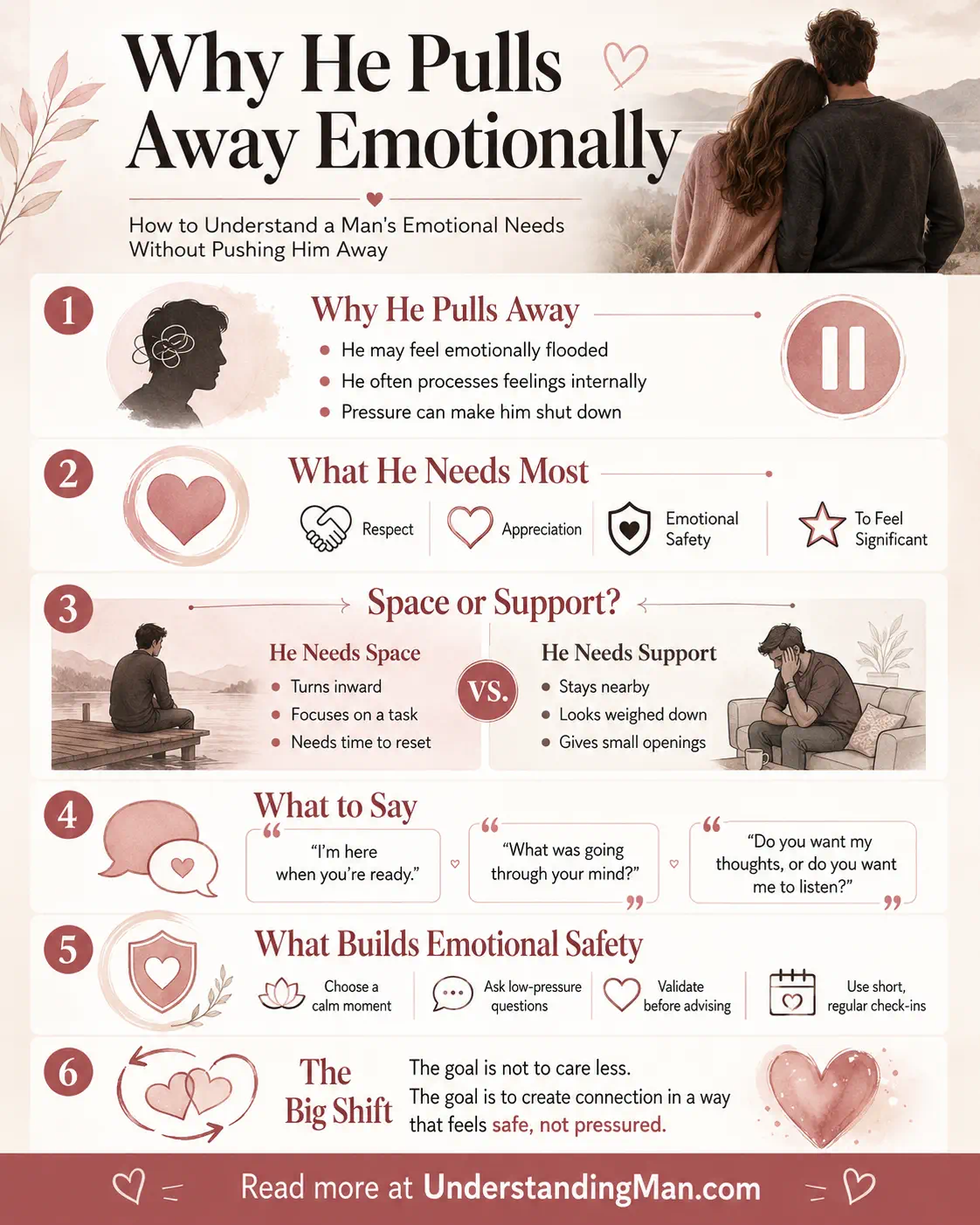
This is one of the most painful and misunderstood patterns in relationships. You feel distance, so you move toward connection. He feels pressure, so he moves toward relief. You read his retreat as rejection, and the emotional gap gets wider.
For many women, closeness feels like talking, clarifying, repairing, and staying emotionally engaged. For many men, especially those who were taught to suppress vulnerability or solve problems privately, emotional intensity can trigger shutdown before it triggers openness.
That does not mean every man is the same. It does mean many men were conditioned to handle stress through silence, distraction, work, fixing, or withdrawal before they ever learned how to talk through it. That same pattern often shows up in the early messages men receive about vulnerability, strength, and self-reliance, which is explored further in Understanding Men’s Unspoken Needs in Your Relationship.
So when you ask what is wrong and he says, “Nothing,” he may not be lying in a manipulative way. He may genuinely not know how to put the experience into words yet. Or he may fear saying it badly, being misunderstood, or feeling exposed.
That is why learning how to understand a man emotionally matters. If you mistake emotional slowness for emotional absence, you may respond in ways that make him feel even less safe opening up.
If you keep wondering why he goes quiet right when you need connection most, this will help you understand what is really happening beneath the distance.
🔥 Click Here to Read Why Men Pull Away
What Hurts So Much When a Man Shuts Down Emotionally?
What hurts most is not just his silence. What hurts most is the meaning your heart starts attaching to that silence.
When a man shuts down, it can make you feel unseen, unchosen, and emotionally alone in the relationship. It can stir fear, self-doubt, and the exhausting urge to keep trying harder just to get back to normal.
This kind of distance is painful because it creates uncertainty. Your mind starts scanning every interaction. You replay conversations. You wonder if he is stressed, upset, losing interest, or quietly giving up on the relationship.
That emotional fog can trigger old wounds too. The fear of being too much. The fear of loving more deeply than you are loved. The fear that if you stop holding everything together, the whole connection will slip through your fingers.
This is where many women begin over functioning. You become the one who starts every meaningful conversation. You try to keep the peace, decode the mood, soften the tension, and reassure him while privately feeling starved for reassurance yourself.
That cycle is exhausting. It also makes it harder to hear what is really happening under the silence.
The hopeful truth is this: when you understand the emotional pattern underneath his withdrawal, you stop reacting only to the surface behavior. Instead of chasing the silence, you begin responding to the deeper need behind it, and that is often where the relationship starts to shift.
What Emotional Needs Do Men Have in a Relationship?
Most men need some combination of respect, appreciation, emotional safety, and a sense that they matter. While every man is different, these needs often shape whether he feels open and connected or guarded and withdrawn.
If you want to understand the emotional needs of a man, it helps to stop focusing only on what he says directly and start noticing what makes him feel safer, stronger, and more received in the relationship.
Many men need respect in a very real emotional sense. Respect is not about submission or never disagreeing. It is about feeling taken seriously, not being talked down to, and not feeling constantly corrected, managed, or subtly diminished.
When a man feels respected, he often relaxes emotionally. He becomes less defensive, less avoidant, and more willing to let you into what is actually going on.
Many men also need appreciation more than they openly admit. They may not ask for praise, but a lot of men quietly feel that they are noticed most when they fall short, not when they are trying. That is why a sincere acknowledgment can go much deeper than it appears on the surface.
A man often needs emotional safety too. He needs to know that if he says something imperfectly, admits confusion, reveals hurt, or shows weakness, he will not immediately lose standing in the relationship. For many men, vulnerability is tied to the fear of being seen as less capable, less masculine, or less dependable.
And beneath all of that is the need to feel significant. He wants to know his presence matters, not just his performance. He wants to feel chosen, valued, and emotionally relevant in your life. For a broader comparison of how emotional needs can differ under stress, see Men’s Needs vs. Women’s Needs: Why He Pulls Away When You Need Connection Most.
When those needs are met, many men become more emotionally reachable. When those needs are repeatedly threatened, many men become quieter, harder to read, and more likely to protect themselves by withdrawing.
When you finally understand what helps a man feel respected, emotionally safe, and deeply connected, the relationship often starts to feel less confusing and more secure.
✨ Click Here to Get the Free E-Book The Attraction Triggers
How Can You Tell Whether He Needs Space or Support?
You can tell the difference by watching whether he is trying to regulate alone or quietly stay connected while struggling. If he turns inward to decompress, he likely needs space; if he stays near you with visible strain, he likely needs calm support.
This distinction matters because many women respond to both situations the same way: by asking more questions. But the right response depends on what kind of withdrawal is happening.
When he needs space, he may become quiet, turn toward a task, go for a drive, focus on work, or simply say he needs a minute. He may be less talkative, but he is not necessarily rejecting you, and in some cases this kind of withdrawal can reflect common stress symptoms and coping responses.
In those moments, a simple line works better than repeated attempts to get him to open up. You might say, “I can tell you need some room right now. I’m here when you’re ready.”
That response keeps the connection open without turning it into pressure.
When he needs support, the signs are slightly different. He may still be quiet, but he stays physically close. He may look weighed down, irritated, tense, or emotionally flat. He may make small comments like “It’s a lot,” “I’m tired,” or “I don’t know.”
That kind of withdrawal often means he does not need a deep discussion yet. He needs your steady presence more than your emotional questioning.
A helpful response might be, “You don’t have to explain it all right now. I just want you to know I’m with you.”
Learning the difference between space and support can change the entire tone of your relationship. It helps you stop taking every quiet moment personally, and it helps him feel less chased when he is already emotionally overloaded.
What Should You Say When He Will Not Open Up?
Say things that lower pressure, invite trust, and give him room to respond without performing. Men often open up more when they feel understood rather than examined.
If a man is shut down, the goal is not to find one magical line that instantly unlocks his heart. The goal is to use language that makes emotional honesty feel safer than emotional hiding.
One of the best ways to do that is to ask about thoughts before feelings. For many men, thoughts are easier to access than emotions at first. Questions like “What was going through your mind?” or “What part of that bothered you most?” feel easier to answer than “How do you feel?”
That matters because once he starts with thoughts, emotion often follows more naturally.
It also helps to use validating responses instead of solutions too early. Many women, especially when they care deeply, want to reassure, advise, or fix. But if he feels redirected too quickly, he may stop talking.
Simple phrases tend to work best:
- “That Makes Sense.”
- “I Can See Why That Stayed With You.”
- “You Don’t Have to Say It Perfectly.”
- “Take Your Time.”
- “I’m Listening.”
- “I’m Not Here to Judge You. I Want to Understand.”
Another powerful question is, “Do you want my thoughts, or do you just want me to listen right now?” That question lowers defensiveness because it gives him control over the direction of the conversation.
If he says, “I’m fine,” instead of challenging him immediately, you might say, “You seem a little off. If you want space, I get that. If you want company, I’m here.”
That kind of response is often far more effective than pushing for clarity before he is ready to give it.
How Do You Talk About Feelings Without Making Him Pull Away?
You talk about feelings more successfully when you choose the right moment, use a softer entry, and focus on connection instead of emotional urgency. Timing and tone often matter just as much as the actual words, and a calmer, more collaborative approach reflects well-established guidance around healthy communication in relationships.
Many hard conversations fail before they begin because they start in the middle of stress, fatigue, distraction, or emotional flooding. If he is exhausted, preoccupied, hungry, or already tense, even a loving conversation can feel overwhelming.
That is why permission-based openings work so well. Instead of launching straight into something heavy, try saying, “There’s something I want to talk about because I care about us. Is now a good time, or would later be better?”
That approach lowers the feeling of ambush. It signals maturity, respect, and emotional self-control.
It also helps to use a simple step-by-step approach when you want to connect without making him shut down.
First, regulate yourself before you start. If you approach him while panicked, angry, or desperate for reassurance, he will likely feel that urgency before he hears your actual message.
Second, choose a moment when both of you have enough emotional bandwidth to stay present.
Third, begin with observation instead of accusation. “You’ve seemed a little weighed down lately, and I wanted to check in” is much easier to receive than “Why have you been acting like this?”
Fourth, ask low-pressure questions that invite rather than interrogate.
Fifth, validate what you hear before giving your opinion or advice.
Sixth, find out what kind of support he wants. Sometimes he wants listening. Sometimes perspective. Sometimes time.
Seventh, if the conversation starts escalating, pause before it becomes damaging. You can say, “I want to keep talking about this, but not in a way that makes us both shut down. Can we take a little break and come back to it?”
This is how you create emotional safety with a man. Not by walking on eggshells, but by speaking in a way that gives the relationship a better chance of staying open.
If you want more real-life phrases, conversation examples, and step-by-step guidance you can use in the moment, there are tools that make this much easier.
📘 Click Here to Get the Free E-Book The Momentum Method
What Is the Difference Between Healthy Space and Emotional Unavailability?
Healthy space leads back to connection, while emotional unavailability becomes a pattern of distance without repair. If he takes time but returns to the conversation, that is different from repeatedly shutting down and never re-engaging.
This distinction matters because some women over-accommodate in the name of understanding. They tell themselves he just needs space when, in reality, he is avoiding emotional responsibility altogether.
Healthy space usually looks like temporary withdrawal followed by some form of reconnection. He may need time to think, calm down, or sort out his emotions. But he comes back. He follows up. He shows that the relationship still matters even if he cannot process everything immediately.
Emotional unavailability looks different. He repeatedly shuts down. He avoids important conversations entirely. He dismisses your needs as too much. He expects endless patience while making little or no effort to grow.
A man can be emotionally reserved and still available. He can be slow and still deeply caring. But if you are always the one circling back, softening the moment, carrying the emotional work, and waiting for him to rejoin the relationship, that is not just a pacing difference. That is imbalance.
Understanding a man’s emotional needs should never require abandoning your own. Empathy is healthy. Self-erasure is not.
So yes, learn the difference between pressure and safety. Learn how he processes emotion. Learn how to respond with wisdom instead of panic. But also stay honest about whether he is meeting you with real effort and real care.
How Do You Build Emotional Safety Over Time?
You build emotional safety through many small moments of steadiness, not one perfect conversation. Men tend to open up more when emotional connection feels consistent, manageable, and free from humiliation.
A lot of women imagine that emotional closeness will arrive through one long breakthrough talk. Sometimes that happens, but more often intimacy grows through repetition. It grows when he learns, again and again, that honesty with you does not automatically lead to conflict, contempt, or pressure.
That means small habits matter.
Brief check-ins often work better than rare emotional deep dives. Ten to twenty minutes. One topic at a time. No stacking five unresolved issues together. No scorekeeping. No trying to solve the entire relationship before bed.
Consistency matters too. If emotional conversations only happen when one of you is upset, then openness starts to feel associated with danger. But if the relationship includes calm, regular moments of connection, he is more likely to stay engaged when harder topics do come up.
Daily behaviors make a difference:
- Thanking him for specific things
- Noticing effort, not only failure
- Asking instead of assuming
- Keeping your tone warm during hard conversations
- Letting silence breathe without rushing to fill it
- Revisiting unfinished topics gently instead of resentfully
Every time he feels heard without being shamed, the next conversation becomes a little safer. Every time you stay grounded instead of reactive, the dynamic becomes a little healthier.
This is what real emotional intimacy usually looks like. Less dramatic than people expect, but often far more sustainable. If you want more practical examples of what creates closeness in everyday life, see 9 Things That Make a Man Feel Truly Connected to You.
FAQ
Why Does My Man Pull Away When I Try to Get Closer?
Many men pull away when closeness feels emotionally intense and they do not yet know how to process what they are feeling. That does not always mean he cares less; it often means he needs less pressure and more emotional safety to stay engaged.
If you keep wondering why he goes quiet right when you need connection most, this will help you understand the pattern more clearly. You can also go deeper into this dynamic in why he pulls away when you need connection most.
🔥 Click Here to Read Why Men Pull Away
How Can I Understand a Man's Emotional Needs Without Pushing Him Away?
You can understand a man’s emotional needs by paying attention to what helps him feel respected, appreciated, emotionally safe, and not rushed. The more you replace pressure with calm curiosity, the more likely he is to open up instead of shut down.
If you want a faster way to see where you really stand with him, start here.
💛 Click Here to Take the Devotion Quiz
What Do Men Need Emotionally in a Relationship?
Most men need some combination of respect, appreciation, trust, emotional safety, and a sense that they matter. While every man is different, those needs often shape whether he feels connected enough to be vulnerable.
If you want to understand what quietly draws a man in and deepens emotional connection, this is a strong next step. You can also read more in understanding men’s unspoken needs in your relationship.
✨ Click Here to Get the Free E-Book The Attraction Triggers
Why Does He Say He's Fine When He's Clearly Not?
He may say he is fine because he does not have words for what he feels yet, or because he feels exposed trying to explain it too quickly. Sometimes “I’m fine” really means “I’m overwhelmed and I need more time before I can talk.”
How Do I Get Him to Open Up Emotionally Without Making Him Feel Pressured?
Start with lower-pressure questions about what he is thinking instead of demanding immediate emotional language. Men often open up more when they feel understood, unjudged, and free to respond at their own pace.
Should I Give Him Space or Keep Trying to Talk to Him?
If he is self-regulating and turning inward, giving him space is usually more helpful than pushing for a conversation. If he stays close but seems weighed down, calm support often works better than either pressure or total withdrawal.
What Should I Say When He Shuts Down Emotionally?
Use language that lowers pressure and keeps the door open, such as “I’m here when you’re ready” or “You don’t have to explain it perfectly.” Short, validating responses help more than emotional interrogation when he is already overwhelmed.
If you want practical language that helps you shift tension into closeness, this can help.
📘 Click Here to Get the Free E-Book The Momentum Method
How Do I Talk About My Feelings Without Making Him Pull Away?
Bring up your feelings at a calm time, start gently, and focus on connection instead of blame. Men usually respond better when the conversation feels respectful, specific, and emotionally manageable.
What Is the Difference Between Healthy Space and Emotional Unavailability?
Healthy space is temporary and leads back to reconnection, while emotional unavailability becomes a pattern of distance without repair. If he regularly avoids important conversations and never comes back to them, the issue may be deeper than needing time alone.
Can a Man Love Me and Still Struggle to Express His Emotions?
Yes, a man can love you deeply and still be emotionally limited, slow to process, or uncomfortable expressing vulnerability. Love and emotional skill are not the same thing, though a healthy relationship still requires effort and growth.
Why Do I Feel So Hurt When He Goes Quiet?
His silence can trigger feelings of rejection, insecurity, and emotional loneliness, especially if you are someone who experiences closeness through conversation. What hurts is often not just the silence itself, but the meaning your heart attaches to it.
How Do I Know If He Needs Support or Just Wants to Be Left Alone?
Look at whether he is trying to regulate privately or staying near you while visibly struggling. If he keeps some physical closeness or gives small emotional signals, he may want support even if he does not know how to ask for it directly.
What Are Signs That a Man Feels Emotionally Safe With Me?
Signs of emotional safety include him sharing more without being forced, returning to hard conversations after space, and showing less defensiveness over time. Emotional safety usually grows through repeated moments where he feels respected, heard, and not shamed.
How Can I Make a Man Feel Emotionally Safe With Me?
You can make a man feel emotionally safe by listening without immediately correcting, validating before advising, and not using his vulnerability against him later. Emotional safety grows when he learns that honesty with you will not cost him his dignity.
Am I Being Understanding, or Am I Making Excuses for Him?
You are being understanding if his need for space still leads to reconnection, effort, and mutual care. You may be making excuses if you are always adapting while he avoids emotional responsibility and leaves your needs unaddressed.
What If I Am the Only One Doing the Emotional Work in the Relationship?
If you are carrying all the emotional labor, the problem is no longer just communication style. A healthy relationship requires mutual effort, not one person endlessly translating, softening, and holding everything together.
How Long Should I Wait for Him to Open Up?
A little time can be healthy, but emotional distance should not become an indefinite pattern with no follow-up. If he consistently needs space, there should still be a reasonable return to the conversation and a real willingness to engage.
Can Appreciation Really Help a Man Open Up More?
Yes, sincere appreciation often helps men feel seen and lowers their defensiveness. When a man feels valued instead of only corrected, he is usually more emotionally available, and many of those trust-building behaviors are covered in 9 things that make a man feel truly connected to you.
What Is the Best Question to Ask a Man Who Won't Open Up?
One of the best questions is, “What was going through your mind when that happened?” It feels less invasive than demanding feelings right away and often leads more naturally into emotional honesty.
How Do I Rebuild Emotional Connection When He Feels Distant?
Rebuilding emotional connection starts with reducing pressure, improving timing, and creating smaller moments of safe connection instead of forcing one big breakthrough talk. Consistency, warmth, and emotional steadiness usually reconnect more effectively than urgency.
If you are ready for a deeper shift in how he sees you and responds to you, this is the strongest next read.
❤️ Click Here to Read How to Make Him Deeply Desire You
What Changes When You Finally Understand His Emotional Language?
When you understand his emotional language, you stop chasing closeness in ways that accidentally create more distance. You begin responding with more steadiness, more clarity, and more wisdom, and that often changes the entire tone of the relationship.
This does not mean everything becomes instantly easy. It does mean you stop wasting your energy on strategies that make him feel cornered when what he actually needs is safety, pacing, or support.
You begin noticing the difference between rejection and overwhelm. You learn how to hear what he means beneath what he says. You stop interpreting every quiet moment as a relationship emergency.
And in that calmer space, many men become more reachable.
That is the deeper hope in all of this. You do not need to love less. You do not need to silence your needs. You do not need to settle for emotional crumbs.
You need a clearer map for how to understand a man’s emotional needs in a way that honors both his pace and your heart.
When you do that, the relationship often starts to feel less like guessing and more like seeing. Less like pushing and more like guiding. Less like fear and more like trust.
If you are ready to stop feeling overlooked and start creating the kind of connection that makes him want to lean in, this is the most natural next read.
❤️ Click Here to Read How to Make Him Deeply Desire You
If you want to go deeper into understanding men, emotional safety, and how to rebuild closeness when distance starts to grow, UnderstandingMan.com can be a natural next step. Sometimes one article helps you understand a moment. Sometimes understanding the deeper pattern is what changes the relationship.
For related reading, you can continue with Become Emotionally Irresistible to Men or, if distance has already built up, Why He Feels Distant: 10 Powerful Ways to Rebuild Emotional Connection With Your Man.
And often, that change begins when you stop asking, “Why is he so hard to reach?” and start asking, “What helps him feel safe enough to stay present?”


Comments
Post a Comment