Why He Pulls Away Emotionally: 7 Clear Signs
You Need CLOSENESS... does he know that?
Article Navigation: How to Understand Him Without Pressure
Quick answer: This guide from understandingman.com explains why he pulls away when you need closeness, what emotional needs men often carry quietly, and how to communicate in a way that feels safe instead of pressured. Use the sections below to learn how to read his need for space or support, what to say when he goes quiet, and how to build emotional connection without losing yourself.
- Key Takeaways: Why He Pulls Away When You Need Closeness
- Why He Pulls Away When You Need Closeness
- Why Does Trying Harder Push Him Away?
- Why Do Emotional Talks Make Him Shut Down?
- What Emotional Needs Do Men Have?
- How Does Respect Help Him Open Up?
- How Can You Tell If He Needs Space?
- How Can You Tell If He Needs Support?
- What Should You Say When He Goes Quiet?
- How Do You Ask About Feelings Without Pressure?
- How Can Hard Conversations Feel Safer?
- What Daily Habit Builds Emotional Connection?
- How Do You Understand Him Without Losing Yourself?
- FAQ
Key Takeaways: Why He Pulls Away When You Need Closeness
Quick answer: When a man pulls away as you reach for closeness, it often means the emotional pressure feels overwhelming, not that he has stopped caring. The healthiest response is to create safety, reduce pressure, and communicate your needs clearly without chasing, blaming, or abandoning yourself.
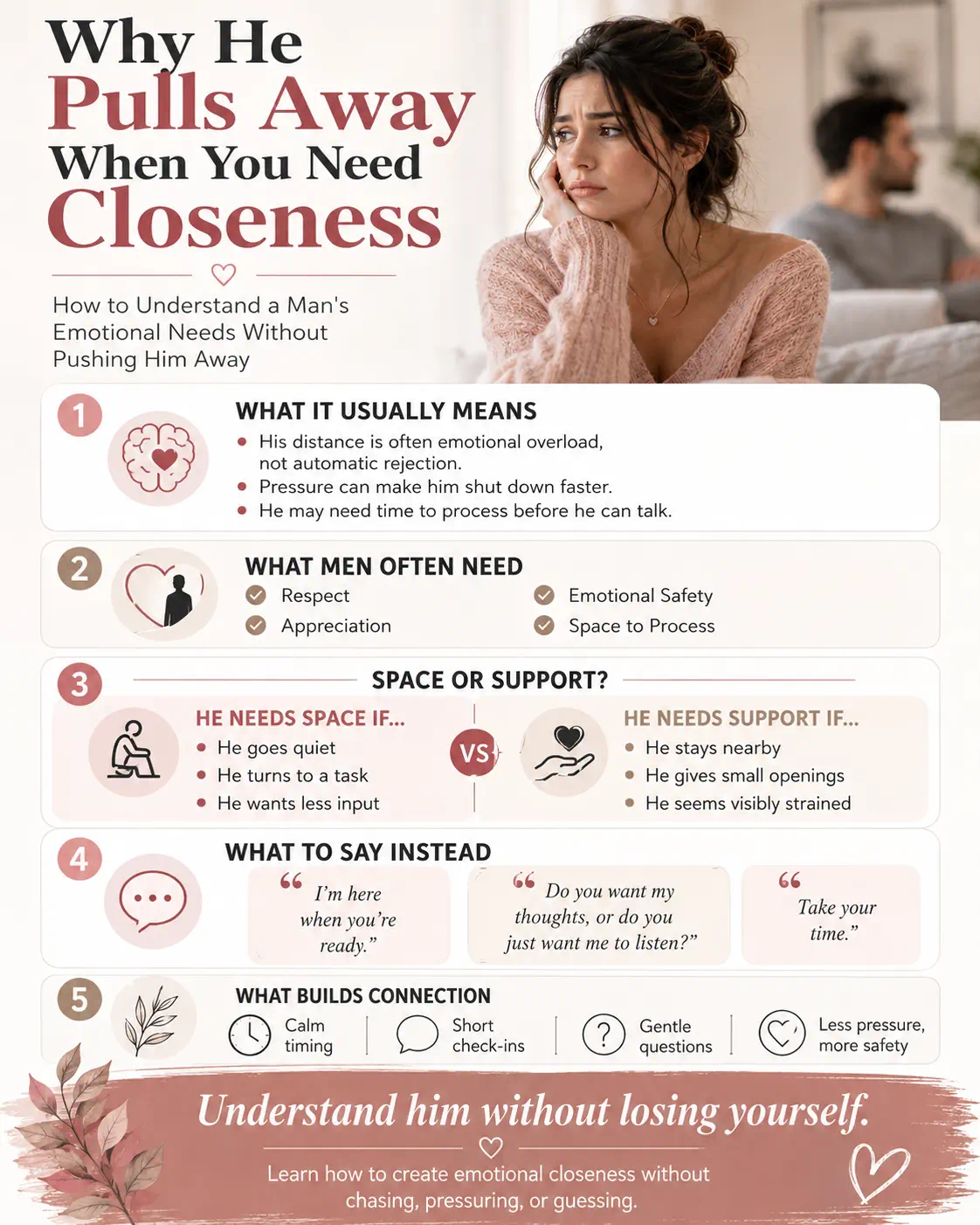
- His silence may be emotional overload, not automatic rejection.
- Many men need space to process before they can explain what they feel.
- Respect, appreciation, trust, and emotional safety often make men more open.
- Pressure usually creates more distance, while calm timing makes connection easier.
- You can understand his needs without ignoring your own need for reassurance.
Why He Pulls Away When You Need Closeness
Direct answer: He may pull away when you need closeness because emotional pressure can make him feel overwhelmed, criticized, or unsure how to respond. Understanding a man's emotional needs starts with creating safety, respect, and space for him to process before expecting him to explain everything perfectly.
You reach for closeness, and he gets quieter. You ask how he feels, and he says, "I'm fine," even though his tone tells you something is clearly off. The harder you try to close the emotional gap, the wider it seems to grow.
If you have been wondering how to understand a man's emotional needs without pushing him away, this guide is for you. That frustrating cycle can make you question everything. You may wonder if he still cares, if you are asking for too much, or if something is fundamentally wrong in the relationship.
But often, what you are experiencing is not a love problem. It is a language problem. Two people can care deeply about each other and still express emotion in completely different ways. You may reach for emotional closeness through conversation, while he may seek emotional balance through quiet, space, action, or time to think.
That difference can feel painful when you do not understand it. His silence can feel like rejection. His need for space can feel like abandonment. His short answers can make you feel like you are the only one trying. But once you understand what he may actually need emotionally, the dynamic becomes easier to read.
This article will help you understand why men pull away, what emotional needs many men struggle to voice, how to tell whether he needs space or support, and what to say when he goes quiet. The goal is not to chase him, fix him, or make yourself smaller. The goal is to build connection in a way he can actually receive.
UnderstandingMan.com was created to help women decode how men think, feel, withdraw, reconnect, and respond to emotional closeness. When you understand the emotional language your man actually speaks, you can stop guessing and start building a calmer, stronger connection.
💗 Want to understand why he pulls away when you need closeness?
If you feel like you are always guessing what he needs emotionally, this can help you understand the deeper pattern behind his distance.
Why Does Trying Harder Push Him Away?
Direct answer: Trying harder can push him away when your effort starts to feel like pressure instead of connection. Many men shut down when they feel expected to explain emotions before they have had time to understand them themselves.
One of the most confusing patterns in relationships is this: the more you try to talk, the more he shuts down. You ask what is wrong. He says nothing. You ask again because you can feel the distance. He becomes more irritated, vague, or quiet. Then you feel hurt because it seems like he is choosing distance over you.
This is where many women misread the moment. His withdrawal may look like emotional indifference, but it may actually be emotional overload. Many men were never taught how to name what they feel in real time. They were taught to stay composed, figure things out alone, avoid appearing weak, and handle stress privately. Guidance from the American Psychological Association on why men struggle to express vulnerability supports the idea that restrictive emotional expectations can shape how boys and men handle distress.
That does not excuse coldness, disrespect, or long-term avoidance. But it does explain why immediate emotional conversation can feel difficult for him. When you ask, "What are you feeling?" he may genuinely not know how to answer yet. When you ask repeatedly, he may feel like he is failing you, and that feeling can make him retreat even more.
For many men, emotional processing happens through action before language. He may drive, work out, fix something, focus on a task, go quiet, or distract himself until his nervous system settles. This does not mean he has no feelings. It means his path to those feelings may not begin with words.
For more on how these early patterns shape male behavior in relationships, see Understanding Men's Needs in a Relationship.
The shift is learning not to interpret every quiet moment as rejection. Sometimes the most connective thing you can do is give him room without turning that room into punishment. Calm space tells him, "You are safe to come back when you are ready." Pressure often tells him, "You are already failing me."
Why Do Emotional Talks Make Him Shut Down?
Direct answer: Emotional talks can make him shut down when the conversation feels urgent, corrective, or impossible to get right. If he believes opening up will lead to criticism, conflict, or more pressure, he may protect himself by going quiet.
The pressure loop usually starts with a real need. You want connection. You want reassurance. You want to know what is happening inside him instead of sitting in uncertainty. Those needs are valid. The problem is that the way you reach for clarity can accidentally create the opposite result.
You ask what is wrong. He says he is fine. You know he is not fine, so you press harder. He feels cornered and becomes more distant. You read his distance as proof that he does not care, so your anxiety rises. Then you ask with more urgency, more emotion, and more frustration. He feels even more inadequate, so he shuts down further.
This cycle is painful because both people are reacting to fear. You may fear losing connection. He may fear failing at emotional communication. You may be trying to pull him closer. He may be trying not to say the wrong thing. Without realizing it, both of you can end up protecting yourselves in ways that hurt the relationship.
A man who already struggles with emotional language may interpret repeated questions as evidence that he is doing something wrong. Even if your intention is love, he may experience it as pressure. When emotional conversations feel like performance tests, he may avoid them altogether.
Breaking this pattern starts with changing the emotional conditions around the conversation. Instead of making the conversation feel urgent, make it feel safe. Instead of asking ten questions in a row, ask one grounded question. Instead of demanding instant vulnerability, offer a calm opening.
Try saying:
- "I can tell something is on your mind. You do not have to talk right now, but I am here when you are ready."
- "I am not trying to pressure you. I just want to understand you better."
- "We do not have to solve this tonight. I just want us to stay connected."
These phrases lower the emotional stakes. They show him that opening up does not have to be perfect, immediate, or dramatic. That is often what makes emotional honesty possible.
🔐 If emotional talks keep turning into silence, distance, or defensiveness, do not keep repeating the same cycle.
The right approach can help him feel safer opening up instead of feeling pressured to perform emotionally.
What Emotional Needs Do Men Have?
Direct answer: Men often need respect, appreciation, trust, emotional safety, physical warmth, and the freedom to process without being constantly corrected. Many men also need to feel wanted, valued, and accepted even when they are not expressing themselves perfectly.
When people talk about emotional needs in relationships, they often focus on communication, affection, vulnerability, and reassurance. Those matter. But for many men, the emotional need underneath all of that is respect.
Respect does not mean blind agreement. It does not mean ignoring your own feelings or avoiding hard conversations. In a healthy relationship, respect means he feels trusted, valued, and seen as capable. It means he does not feel constantly managed, corrected, compared, or treated like a project.
Many men become more emotionally available when they feel respected first. If he feels criticized every time he opens up, he will open up less. If he feels like his efforts are invisible, he may stop offering as much. If he feels like he can never get it right, he may retreat into silence or defensiveness.
Appreciation is another emotional need men often carry quietly. Many men will not say, "I need to hear that I matter to you." But they feel the absence of it. A simple "I appreciate how hard you have been trying," or "I noticed what you did, and it meant a lot," can land more deeply than you realize.
Words of affirmation matter too. A man may not always ask for verbal reassurance, but he still wants to feel like his presence matters. He wants to know that you notice his effort, not only his mistakes. For a broader overview of common male emotional priorities, this piece on the emotional needs of men is a useful reference.
Emotional safety is also essential. Many men need to know that being honest will not cost them your respect. If he admits stress, fear, confusion, or insecurity, he needs to feel that you will not use it against him later. That kind of safety is what allows vulnerability to grow. Research on feeling understood and appreciated in a relationship also supports the importance of partner responsiveness, which is closely tied to closeness, satisfaction, and commitment.
The emotional needs he may never voice directly are often the ones shaping his behavior most. He may need to feel chosen. He may need to feel trusted. He may need to feel like he is enough. He may need to feel that he can be imperfect and still loved.
🧠 Want a deeper look at what men quietly need but rarely say out loud?
Understanding his emotional needs can change the way you communicate, connect, and respond when he pulls back.
How Does Respect Help Him Open Up?
Direct answer: Respect helps him open up because it lowers defensiveness and makes emotional honesty feel safer. When a man feels valued instead of judged, he is more likely to stay present in difficult conversations.
If a man feels like every emotional conversation turns into a list of what he is doing wrong, he may start avoiding those conversations before they even begin. This is not because your feelings do not matter. Your feelings absolutely matter. But delivery affects whether he can actually hear you.
Respectful communication does not mean softening the truth so much that nothing changes. It means speaking in a way that keeps the door open. Instead of saying, "You never open up to me," you might say, "I want to feel closer to you, and I am trying to understand what helps you feel safe talking to me."
That version still names the issue, but it does not attack his identity. It invites him into the solution instead of putting him on trial.
Appreciation works the same way. When you acknowledge what he is doing right, he becomes less guarded about what needs work. Many men are more responsive to encouragement than emotional pressure. A man who feels admired is often more willing to stretch. A man who feels constantly criticized may focus more on protecting himself than connecting with you.
Try using specific appreciation instead of general praise:
- "I appreciated that you stayed in the conversation even though it was uncomfortable."
- "It meant a lot that you listened instead of shutting it down."
- "I noticed you trying, and I do not want that to go unseen."
- "I respect how seriously you take responsibility, even when you do not say much."
Specific appreciation tells him exactly what behavior builds connection. It reinforces the kind of emotional presence you want more of without making him feel controlled.
This is especially important for women who feel emotionally starved in their relationships. When you have gone a long time without feeling close, it is easy to lead with frustration. But if your goal is reconnection, appreciation often opens a door that pressure keeps closing.
How Can You Tell If He Needs Space?
Direct answer: He may need space if he goes quiet, gives short answers, turns toward a task, or seems focused on regulating himself privately. In those moments, calm space usually works better than repeated questions or urgent emotional demands.
One of the hardest parts of understanding a man emotionally is knowing whether to move closer or give him room. If you move closer when he needs space, he may feel pressured. If you pull away when he needs support, he may feel alone. The key is learning to read the difference.
When he needs space, he may become quiet, give short answers, turn toward a task, go for a drive, work out, or say he does not want to talk. His energy usually says, "I need less input right now." In that moment, pushing for a full emotional conversation can make him feel overwhelmed.
A calm response might be:
"I can see you need some breathing room. I am not going to push. I am here when you are ready."
That sentence does two important things. It gives him room, and it keeps connection intact. You are not punishing him with coldness. You are not chasing him with anxiety. You are showing steadiness.
Giving space does not mean pretending your needs do not matter. It means choosing the timing that gives the conversation the best chance to succeed. If he needs time, you can respect that while still expecting the conversation to come back around later.
A healthy version of space has a return point. You might say, "I understand that you need time. I am okay giving you space, but I do need us to come back to this tonight or tomorrow." That keeps space from turning into avoidance.
How Can You Tell If He Needs Support?
Direct answer: He may need support if he is quiet but stays physically nearby, gives small emotional openings, or seems visibly strained. In those moments, your calm presence may help more than advice, questions, or solutions.
Support looks different from pressure. He may not be ready for a deep conversation, but he may still want to feel that you are there. He may sit near you without saying much. He may say, "It has been a lot," "I do not know," or "I am just tired." He may seem irritated, heavy, distracted, or emotionally strained, but he does not fully leave the connection.
In those moments, he may not need a solution. He may need your steadiness. Many women accidentally offer too much language when a man is already overloaded. They ask questions, give advice, explain what he should do, or try to pull out feelings he has not organized yet. But sometimes the most intimate response is quieter.
Try this instead:
- Stay near without forcing conversation.
- Use a softer tone instead of a questioning tone.
- Offer presence instead of advice.
- Let silence be safe instead of awkward.
- Reassure him that he does not have to explain perfectly.
You might say, "You do not have to explain it perfectly. I can just sit with you for a minute." For many men, that kind of support feels far safer than being asked to unpack everything immediately.
The difference is simple: space means he is trying to regulate privately. Support means he is struggling but still allowing your presence. Once you can tell the difference, you stop guessing and start responding with more confidence.
What Should You Say When He Goes Quiet?
Direct answer: When he goes quiet, say something calm that removes pressure and keeps the door open. The best phrases show that you are available, not judging him, and not demanding instant emotional performance.
Silence can be triggering when you want closeness. It can make you want to ask more questions, fill the space, or demand an answer so you can calm your own anxiety. But if he is already overwhelmed, too many words can make the moment worse.
The goal is not to ignore the silence. The goal is to respond to it in a way that keeps emotional safety intact.
Try phrases like:
- "You do not have to get this perfectly out."
- "Take your time. I am not going anywhere."
- "That makes sense."
- "I am not here to judge you. I just want to understand."
- "Whenever you are ready, I am listening."
- "We do not have to solve this right now."
- "I can see this is hard to talk about."
These phrases work because they reduce the fear of doing it wrong. They tell him that emotional honesty does not have to be polished. He does not have to perform vulnerability perfectly to be accepted.
One of the most powerful questions you can ask is:
"Do you want my thoughts, or do you just want me to listen right now?"
That question gives him a choice. It tells him you are not automatically moving into advice, correction, or problem-solving. It also helps you avoid one of the most common communication mismatches in relationships: one person wants to vent, while the other starts fixing.
Another helpful shift is asking about thoughts before feelings. Instead of asking, "How do you feel?" try, "What was going through your mind when that happened?" This lets him enter the conversation through analysis first. Once he feels less exposed, the emotional layer may come out more naturally.
For practical communication ideas that echo this approach, see this guide on how to get a man to emotionally open up.
💬 Need the right words when he shuts down?
If you are tired of saying the wrong thing and watching him pull farther away, a calmer communication approach can help you reach him without chasing.
How Do You Ask About Feelings Without Pressure?
Direct answer: Ask about feelings without pressure by using calm, specific, low-pressure questions instead of urgent emotional demands. Start with curiosity, give him room to answer imperfectly, and avoid stacking multiple questions at once.
Many women ask emotional questions because they want closeness, not control. But the way a question is asked can determine whether he opens up or shuts down.
Compare these two approaches:
"Why will you never tell me how you feel?"
That question may be honest, but it also sounds like an accusation. It puts him on defense immediately.
Now compare it with:
"I want to understand you better. What helps you talk when something is bothering you?"
That question is still direct, but it feels safer. It invites him to share information instead of defend himself.
Better emotional questions are usually specific, calm, and limited. Instead of asking everything at once, ask one question and let the answer breathe. A man who needs time to process may shut down if he feels like he is being emotionally interviewed.
Helpful questions include:
- "What was the hardest part of that for you?"
- "What do you need from me right now: space, support, or just quiet?"
- "Did that feel frustrating, stressful, or just draining?"
- "Would it be easier to talk later tonight?"
- "What would help this conversation feel less pressured?"
These questions give him structure. Many men respond better when the emotional topic is not wide open. A question like "How do you feel about everything?" can feel too broad. A question like "Did that feel frustrating or disappointing?" gives him an easier entry point.
The biggest rule is this: do not turn one answer into ten follow-up questions. If he shares something small, treat it like progress. Reflect it back. Let him feel successful in the conversation. That makes him more likely to share again next time.
How Can Hard Conversations Feel Safer?
Direct answer: Hard conversations feel safer when they happen at the right time, with clear intent, calm pacing, and permission to pause. A man is more likely to stay emotionally present when the conversation feels respectful instead of urgent or attacking.
Timing matters more than most people realize. A serious emotional conversation is much less likely to go well when either person is tired, hungry, distracted, stressed, or already defensive. The issue may be important, but the timing can still be wrong.
Before diving into a difficult topic, try asking:
"Is now a good time, or should we find a better window tonight?"
That question signals respect. It tells him you care about the conversation going well, not just getting your point out immediately. It also gives both of you a better chance of being emotionally available.
Everyday conversations play an important role in wellbeing and connection, and small timing choices can make communication feel more manageable. For more context, see this piece on conversations as key to wellbeing.
Another way to make hard conversations safer is to name your intention upfront. Instead of starting with the complaint, start with the goal. The Gottman Institute describes this as using a gentle start-up for hard relationship conversations, where you talk about your feelings and needs without blaming your partner.
Try saying:
- "I do not want to fight. I want us to understand each other."
- "This matters to me because I want to feel close to you."
- "I am bringing this up because I care about us, not because I want to attack you."
- "I want to talk about this in a way that does not make either of us shut down."
When the conversation starts to escalate, pause before it becomes damaging. A pause is not avoidance when it has a return point. You can say, "I want to keep talking about this, but I think we both need a few minutes. Can we come back to it in half an hour?"
That kind of pause protects the conversation. It gives both people time to regulate instead of saying things from a reactive place. The goal is not to win the moment. The goal is to keep the connection strong enough to solve the issue.
What Daily Habit Builds Emotional Connection?
Direct answer: A short, consistent check-in builds more emotional connection than occasional intense conversations. Ten to twenty minutes of calm, focused conversation can help a man feel safer opening up over time.
Many couples wait until the emotional distance becomes painful before they talk. By then, the conversation carries too much pressure. One person wants immediate repair, and the other feels overwhelmed by the weight of everything that has been building.
A better approach is a brief, consistent check-in. This does not need to be dramatic. It does not need to cover every issue in the relationship. In fact, it should not. The point is to create a rhythm of connection that feels manageable.
Try setting aside ten to twenty minutes and focusing on one topic at a time. No stacking five unresolved issues. No turning it into a relationship audit. No using the moment to unload every frustration from the week.
A simple check-in could include:
- "What felt good between us this week?"
- "Was there anything that felt off or unresolved?"
- "What is one thing we could do to feel more connected?"
- "Do you need more space, more affection, or more support this week?"
This habit works because it lowers the intensity around emotional connection. Instead of every conversation feeling like a crisis, talking becomes normal. Smaller moments of honesty create a track record of safety. Over time, that track record matters.
Every calm exchange teaches his nervous system something important: talking to you does not have to become a fight. Sharing a little does not mean being overwhelmed. Being honest does not mean losing respect.
Longitudinal research on communication patterns supports the value of regular emotional communication for closeness and relationship stability. You can explore related research here: research on emotional communication.
The goal is not to force deep vulnerability every day. The goal is to build emotional consistency. When connection becomes a steady habit instead of a high-pressure event, men who normally withdraw often become more willing to engage.
How Do You Understand Him Without Losing Yourself?
Direct answer: You understand him without losing yourself by offering emotional safety while still honoring your own need for connection. Supporting him does not mean accepting emotional neglect, chasing distance, or pretending your needs do not matter.
This is the part many women need to hear clearly: understanding a man does not mean over-functioning for him. It does not mean doing all the emotional work alone. It does not mean becoming endlessly patient while your needs disappear.
Healthy understanding has boundaries. You can recognize that he processes emotions differently and still need communication. You can give him space and still expect him to come back. You can be compassionate toward his emotional patterns and still ask for growth.
The goal is not to become the woman who never asks for anything. The goal is to ask in a way that creates connection instead of pressure, while also being honest about what you need to feel secure.
You might say:
"I understand that you need time to process. I can respect that. I also need us to come back to the conversation instead of leaving it unresolved."
That sentence holds both truths. It respects his emotional style, and it protects your emotional needs. This is where real relationship maturity begins.
Learning how to understand a man's emotional needs without pushing him away comes down to a shift in approach. It means recognizing that withdrawal is not always rejection, pressure often activates avoidance, and emotional safety usually creates more openness than emotional force.
Respect what he expresses indirectly. Learn the difference between space and support. Use phrases that invite rather than interrogate. Pace emotional conversations so they feel safe, not urgent. Appreciate his effort when he tries, even if the attempt is imperfect.
None of this asks you to need less love. It asks you to understand the emotional language your man may actually speak. That understanding can change the entire texture of the relationship, often gradually, but meaningfully.
For concrete steps you can practice to increase emotional closeness, read Become Emotionally Irresistible to Men.
If emotional distance has already grown between you, you may also want this step-by-step guide on how to rebuild emotional connection when he feels distant.
UnderstandingMan.com is built to help women understand how men think, feel, withdraw, reconnect, and respond to emotional closeness. When you stop guessing and start understanding the deeper emotional pattern, connection becomes less about pressure and more about trust.
✨ Ready to stop guessing and start understanding him on a deeper level?
If you want more emotional closeness, less confusion, and a stronger connection with your man, this is the next step.
Click Here to read Article: How to Make Him Deeply Desire You.
FAQ
Why Does He Pull Away When I Try to Talk About Feelings?
Direct answer: He may pull away when you try to talk about feelings because the conversation feels overwhelming, urgent, or impossible for him to answer correctly in the moment. Many men need time to process privately before they can explain what they feel clearly.
This does not automatically mean he does not care about you. It may mean he does not yet feel emotionally safe, prepared, or regulated enough to have the conversation without shutting down. If this pattern keeps happening, read this deeper guide on signs he is pulling away emotionally so you can tell whether his distance is temporary stress, emotional overload, or a bigger relationship pattern.
💗 Still wondering why he pulls away right when you need him most?
This can help you understand the deeper emotional pattern behind his distance so you stop blaming yourself and start responding with more clarity.
How Do I Understand a Man's Emotional Needs Without Pushing Him Away?
Direct answer: You understand a man's emotional needs without pushing him away by creating emotional safety instead of forcing emotional access. He is more likely to open up when he feels respected, trusted, appreciated, and free to process before being expected to explain everything.
The key is to stop treating every quiet moment as rejection. Sometimes he needs space to regulate, and sometimes he needs quiet support. When you learn the difference, your response becomes calmer, more confident, and less driven by fear.
What Does a Man Need Emotionally From a Woman?
Direct answer: A man often needs respect, appreciation, emotional safety, trust, affection, and the feeling that he is valued even when he is imperfect. Many men also need to feel that opening up will not lead to criticism, judgment, or a loss of respect.
For many men, emotional connection is easier when they do not feel managed, corrected, or treated like a project. This does not mean you ignore your own needs. It means you communicate in a way that protects connection while still being honest about what matters to you. For a deeper breakdown of how relationship needs can show up differently, read men's needs vs women's needs in relationships.
🧠 Want to know what he needs emotionally but may never say out loud?
A quick quiz can help you see what may be missing in the connection and what kind of emotional response he may be craving most.
What Should I Say When He Says I'm Fine but Clearly Isn't?
Direct answer: When he says he is fine but clearly is not, respond with calm observation instead of pressure. A helpful phrase is, "I can tell something feels off, but I am not going to push you. I am here when you are ready."
This keeps the door open without forcing him to perform emotional honesty on command. If he feels cornered, he may shut down more. If he feels safe, he is more likely to come back to the conversation when he has had time to process.
Should I Give Him Space or Try to Comfort Him?
Direct answer: Give him space if he seems task-focused, quiet, short, or clearly trying to regulate himself privately. Offer comfort if he stays nearby, gives small emotional openings, or seems visibly strained but not fully disconnected.
Space and support can look similar at first, which is why many women feel confused. The difference is in his energy. If he seems to need less input, give him room. If he seems heavy but still receptive to your presence, stay calm and steady without forcing a deep conversation.
How Can I Get Him to Open Up Without Pressuring Him?
Direct answer: You can help him open up by asking low-pressure questions and letting him answer imperfectly. Start with thoughts before feelings, such as, "What was going through your mind when that happened?" instead of immediately asking, "How do you feel?"
Many men open up more easily when the conversation does not feel like an emotional test. Ask one question at a time, pause, and reflect back what he says. If he shares something small, treat it as progress instead of pushing for more immediately.
💬 Need the right words to help him open up instead of shutting down?
These attraction-based communication cues can help you speak in a way that feels calmer, safer, and easier for him to respond to.
Why Do Men Shut Down During Serious Relationship Talks?
Direct answer: Men may shut down during serious relationship talks when the conversation feels like criticism, conflict, or a demand for instant vulnerability. If he thinks he cannot say the right thing, he may protect himself by going quiet.
This does not mean the conversation should be avoided. It means the emotional setup matters. A clear, respectful opening like, "I do not want to fight. I want us to understand each other," can lower defensiveness and make the conversation safer.
🔐 If serious talks keep turning into distance, silence, or defensiveness, change the pattern before it gets deeper.
The right method can help you rebuild emotional momentum without chasing him, pressuring him, or repeating the same painful cycle.
How Do I Make Him Feel Emotionally Safe With Me?
Direct answer: You make him feel emotionally safe by showing that honesty will not be punished, mocked, stored for later, or used against him. Emotional safety grows when he feels heard, respected, and accepted even when he does not explain himself perfectly.
Use calm validation before advice. Say things like, "That makes sense," "Take your time," or "I am not here to judge you." These phrases help him feel that he can be real without having to perform strength or perfection.
How Do I Talk About My Needs Without Making Him Feel Attacked?
Direct answer: Talk about your needs by naming the connection you want instead of leading with what he is doing wrong. For example, say, "I want to feel closer to you," instead of, "You never open up to me."
This approach still honors your feelings, but it gives the conversation a better chance of staying productive. The goal is not to water down your truth. The goal is to express it in a way he can hear without becoming defensive or shutting down.
What If He Needs Space but I Need Reassurance?
Direct answer: If he needs space but you need reassurance, respect his processing time while asking for a clear return point. You might say, "I can give you space, but I need us to come back to this later so it does not feel unresolved."
This protects both people. He gets room to regulate, and you do not have to sit in indefinite uncertainty. Healthy space should not become avoidance. It should create enough calm for the conversation to continue more safely later.
Why Is My Husband Giving Me the Silent Treatment?
Direct answer: Your husband may give you the silent treatment because he feels overwhelmed, defensive, emotionally flooded, or unsure how to express what he needs. But if silence becomes punishment, control, or repeated avoidance, it should be taken seriously.
There is a difference between needing space and using silence to disconnect from the relationship. If his silence leaves you confused, anxious, or emotionally shut out, read this guide on why your husband gives you the silent treatment so you can recognize the unspoken needs underneath the behavior and know when the pattern is becoming unhealthy.
How Often Should We Have Emotional Check-Ins?
Direct answer: Emotional check-ins work best when they are short, consistent, and not overloaded with too many issues at once. Ten to twenty minutes focused on one topic can build more trust than occasional intense talks that leave both people drained.
The goal is to make emotional connection feel normal instead of dramatic. A simple weekly check-in can help both partners feel safer, heard, and less blindsided by unresolved tension.
Does Understanding Him Mean Ignoring My Own Needs?
Direct answer: No, understanding him does not mean ignoring your own needs. It means learning how he processes emotions while still being honest about what you need to feel secure, loved, and connected.
You can be compassionate without over-functioning. You can give him space without accepting emotional neglect. You can understand his patterns while still expecting maturity, communication, and effort in return.
✨ Want to feel desired, chosen, and emotionally connected without losing yourself?
This next step can help you understand what makes a man feel drawn closer instead of pressured, distant, or emotionally guarded.
Click Here to read Article: How to Make Him Deeply Desire You.
What If He Never Opens Up No Matter What I Do?
Direct answer: If he never opens up no matter what you do, the issue may be deeper than your communication style. You can create emotional safety, but you cannot do the emotional work for both people.
A healthy relationship requires effort from both sides. If you are consistently patient, respectful, and clear, but he still refuses to communicate, reconnect, or take responsibility, it may be time to look at the larger pattern. Understanding him should not mean carrying the whole relationship alone.


Comments
Post a Comment