Why Does My Husband Go Quiet? 7 Cues Women Miss
Man's Emotional Cues

You know that sinking feeling when the man you love gets quiet, and suddenly the whole room feels colder.
Have you ever sat beside him on the couch, watched him stare at his phone, heard his short answers, and wondered, “Is he tired, angry, stressed, or pulling away from me?”
That kind of silence can feel louder than an argument. His jaw looks tight. His answers feel flat. His eyes barely meet yours. You ask if he is okay, and he says, “I’m fine,” but your heart does not believe him. You start searching his face for clues. You replay your last conversation. You wonder if you did something wrong. You try to stay calm, but your mind keeps building painful stories.
This is why learning how to read your man’s emotions without guessing matters.
You are not trying to become a mind reader. You are trying to stop living in emotional confusion every time he gets quiet, distant, tense, or hard to reach. When you understand his body language, emotional cues, speech patterns, and withdrawal signals, you can respond with more calm instead of reacting from fear.
At UnderstandingMan.com the goal is to help women understand how men think, process emotion, communicate under stress, and build connection. When you understand what his silence may mean, you stop treating every quiet moment like rejection and start seeing the pattern underneath the behavior.
Article Navigation: What Will You Learn About Why He Goes Quiet?
This guide explains why he goes quiet, how to read his emotional cues, how to tell stress from withdrawal, and what to say when your man seems distant.
Why Does He Go Quiet When He Feels Overwhelmed?
He may go quiet when he feels overwhelmed because silence can be his way of regulating stress, avoiding conflict, thinking through pressure, or trying not to say something reactive.
That does not mean his silence never hurts. It does. Especially when you are craving closeness, reassurance, or emotional repair. But his quiet is not always proof that he does not care.
Many women experience the same painful pattern. He gets quiet, and you immediately feel the distance. You sense something changed, but he does not explain it. The less he says, the more your mind works. You start trying to decode every little cue. Was his tone colder than usual? Did he pull away when you touched him? Did he answer differently than he normally does? Did he seem annoyed when you asked what was wrong?
The deeper pain is not only that he is silent.
The deeper pain is that you do not know what his silence means.
That uncertainty can trigger fear fast. It can make you feel like you are standing outside a locked door, trying to figure out whether he needs space, whether he is upset with you, or whether the relationship is slowly changing.
Here is the hope: when you learn how men often show emotional stress, you can stop turning every unclear signal into a worst-case story. You can learn to pause, observe, and ask better questions.
His silence may mean stress. It may mean sadness. It may mean anger. It may mean fatigue. It may mean he needs a moment to decompress. It may also mean there is a deeper issue that needs to be addressed.
The key is learning how to tell the difference.
Why Doesn’t He Show Emotions Like You Do?
Your man may not show emotions the way you do because many men are socially trained to restrict vulnerable emotions and express distress through silence, action, irritability, or withdrawal instead of direct emotional language.
Many men grow up learning that sadness, fear, insecurity, and emotional need should be hidden. They may be praised for being strong, calm, useful, unbothered, or in control. Over time, that creates a pattern: he may feel deeply, but his emotional expression may look smaller, quieter, flatter, or harder to read.
Research on masculinity and emotional expression has found that many men are conditioned to restrict vulnerable emotions while allowing anger or stoicism to seem more acceptable. This pattern is discussed in research on male gender norms and emotional expression.
That matters because you may be waiting for him to express emotions in a way that feels natural to you.
You may expect him to say, “I feel overwhelmed.”
Instead, he may show you short answers, a flat tone, tension in his body, more time alone, irritability, problem-solving instead of emotional reassurance, or a quiet wall that appears before he has the words to explain what is happening.
This does not excuse poor communication. It explains why his signals can be easy to misread. When you understand that his emotional language may be more behavioral than verbal, you stop asking, “Why does he not feel anything?” and start asking, “How does he show emotion when he does not yet know how to say it?”
That shift helps you respond with more clarity.
How Do You Read His Emotions Without Guessing?
You read his emotions without guessing by comparing his current behavior to his normal baseline, watching for repeated emotional cues, and asking one calm question before assuming what his silence means.
The biggest mistake is treating one cue as proof.
A tight jaw does not automatically mean he is angry with you. A short answer does not automatically mean he is losing interest. A quiet night does not automatically mean the relationship is in trouble. A need for space does not automatically mean he is rejecting you.
To read him more accurately, separate what you observe from what you assume.
Observation: “He has been quieter than usual tonight.”
Assumption: “He must be mad at me.”
Better interpretation: “Something may be weighing on him, but I need more information before I decide what it means.”
That difference is everything.
When you are anxious, his neutral expression can look like disapproval. When you are craving closeness, his need for quiet can feel like rejection. When you already feel disconnected, his silence can seem like proof that you are alone in the relationship.
Research on empathic accuracy shows that close partners can read each other with some accuracy, but their own emotional state can shape how they interpret the other person’s cues. You can read more about this research area through studies on empathic accuracy in relationships.
So the goal is not to ignore your intuition. The goal is to slow your conclusion.
You can trust that you noticed something changed without immediately deciding what the change means.
What Are the 7 Clear Emotional Cues He Is Sending?
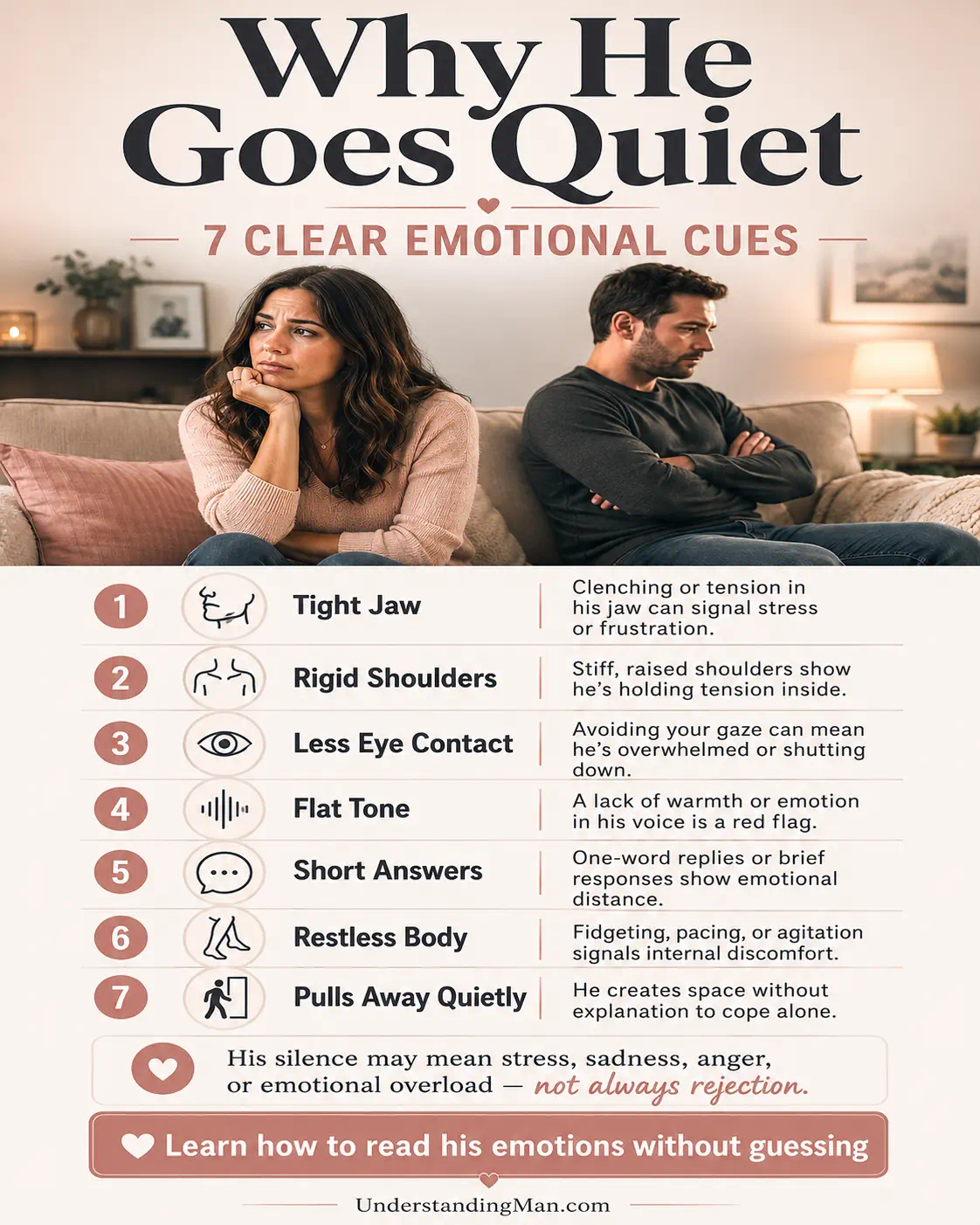
The seven clearest emotional cues he may be sending are changes in his jaw, shoulders, eye contact, tone, speech rhythm, movement, and willingness to reconnect.
These cues matter because they help you move from guessing to observing. Instead of saying, “He is distant, so he must not care,” you can say, “His body, tone, and behavior seem different from his baseline, so something may be happening internally.”
1. His jaw looks tight or locked. A tight jaw can be a sign of stress, frustration, emotional restraint, or internal pressure. If his face looks tense but he is not speaking much, his body may be showing what his words are not ready to explain.
2. His shoulders look rigid or heavy. Rigid shoulders can signal stress or defensiveness. Slumped shoulders may suggest sadness, exhaustion, or emotional heaviness. The difference matters because tension often needs calm, while heaviness often needs gentleness.
3. His eye contact changes. Less eye contact can mean he is overwhelmed, ashamed, distracted, avoidant, tired, or emotionally withdrawn. Do not assume one meaning. Compare it to how he normally looks at you when he is relaxed.
4. His voice sounds flat, clipped, or colder than usual. A flat tone can signal shutdown, sadness, or emotional overload. A clipped tone may signal irritation, pressure, or defensiveness. His tone may reveal emotional tension before he admits anything is wrong.
5. His answers become shorter than normal. Short answers can mean he is tired, stressed, trying to avoid conflict, or not ready to talk. The important question is whether he returns to warmth later or stays emotionally closed.
6. His body becomes restless. Pacing, fidgeting, tapping, repetitive movement, or shallow breathing can suggest stress or nervous-system activation. His body may be trying to release pressure he has not put into words.
7. He pulls away but does not explain why. Withdrawal can be temporary decompression, emotional shutdown, or avoidance. The difference depends on how long it lasts, whether kindness remains, and whether he eventually comes back into connection.
These cues are not a script for diagnosing him. They are a framework for reading the moment more wisely.
How Can You Tell Stress, Anger, Sadness, and Withdrawal Apart?
You can tell stress, anger, sadness, and withdrawal apart by watching whether his energy becomes tense, outward, collapsed, or distant.
Not all emotional distance means the same thing. This is where many women accidentally respond in a way that makes the moment worse. If he is sad and you respond as if he is angry, he may feel misunderstood. If he is stressed and you respond as if he is rejecting you, he may feel pressured. If he is shutting down and you pretend everything is fine, the distance may grow.
A man’s body often shows stress before his words do, so watch for physical cues like a tight jaw, rigid shoulders, shallow breathing, restless movement, fidgeting, pacing, or a clipped tone. The American Psychological Association explains that stress can affect the body through physical stress responses like muscle tension, which makes body language an important clue when you are trying to understand whether he is overwhelmed, not just distant.
Research on emotional and anger cues shows that anger often has a recognizable physical pattern, including tense posture, narrowed eyes, and forceful movement. You can read more about anger expression cues in this research on anger and nonverbal signals.
The takeaway is simple: sadness often moves inward, anger often moves outward, stress often creates tension, and withdrawal often creates distance.
When you can tell those apart, you stop responding to every emotional shift the same way.
How Do You Know if He Needs Space or Is Pulling Away?
You know he needs space rather than pulling away when the distance is temporary, respectful, and followed by a natural return to warmth or normal connection.
This is one of the biggest emotional questions women ask: “Does he just need space, or is he pulling away from me?”
Healthy space usually has a return point.
He may come home quiet. He may need to shower, eat, work out, sit alone, or scroll for a while before he can be present. That may not feel ideal, but if he returns to warmth, kindness, and connection, it may simply be how he decompresses.
Healthy decompression often looks like this:
- He gets quiet for a while.
- He still treats you with basic kindness.
- He does not punish you with silence.
- He gradually becomes warmer.
- He reconnects later.
- He can talk when the timing is better.
Pulling away feels different.
Emotional pulling away may look like this:
- He stays distant for days.
- He avoids repair.
- He acts cold but refuses to explain why.
- He makes you feel like a burden for needing clarity.
- He disconnects emotionally but expects you not to notice.
- He uses silence to control, punish, or avoid accountability.
The difference is not whether he ever needs space. Everyone needs space sometimes.
The difference is whether connection returns.
A strong way to protect both needs is to say:
“I respect that you may need space. I also need us to come back to each other instead of staying disconnected.”
That sentence is emotionally mature because it does not chase, accuse, or collapse. It gives room for his regulation while still honoring your need for connection.
What Are the Most Common Mistakes Women Make When Reading Him?
The most common mistake women make when reading him is turning his silence into a painful conclusion before asking what is actually happening.
This usually happens because you care. When the relationship matters, every shift feels important. His tone matters. His timing matters. His body language matters. His silence matters. But when your nervous system is activated, fear can start sounding like intuition.
Here are the most common misreads:
Misread 1: “He is quiet, so he must be mad at me.”
He may be mad, but he may also be tired, stressed, overwhelmed, distracted, ashamed, or trying to avoid saying something reactive.
Misread 2: “He gave me a solution, so he does not care about my feelings.”
Many men show care through problem-solving. That may not be the emotional validation you need, but it does not always mean he is cold.
Misread 3: “He needs space, so he must be losing interest.”
Sometimes space is how he regulates stress. The real question is whether he returns to connection after that space.
Misread 4: “His serious face means something is wrong.”
A neutral, focused, or tired expression can look negative when you already feel anxious.
Misread 5: “If he loved me, I would not have to ask.”
Even loving men may need clear, calm communication. Expecting him to automatically know what you need can create frustration on both sides.
The better approach is this:
Notice the cue. Pause the story. Ask one grounded question.
That is how you protect your emotional peace while still staying connected.
What Should You Do When He Suddenly Seems Different?
When he suddenly seems different, you should pause, name only what you observe, compare it to his normal behavior, and ask one low-pressure question.
Here is the step-by-step process.
Step 1: Pause before you personalize it.
Tell yourself, “I noticed a shift, but I do not know the cause yet.” This keeps anxiety from taking over the whole conversation.
Step 2: Name the observation, not the accusation.
Do not start with, “You are mad at me.” Start with, “You seem quieter than usual tonight.”
Step 3: Compare it to his baseline.
Ask yourself whether this is unusual or whether he often needs time to decompress after work, conflict, stress, or responsibility.
Step 4: Ask one calm question.
Use a question that invites him to share without making him feel interrogated.
Step 5: Give him a simple choice.
Some men respond better when the emotional request feels clear. Try: “Do you need space, support, or just someone to listen?”
Step 6: Do not punish the first honest answer.
If he finally says, “I’m stressed,” do not immediately reply, “Why did you not tell me sooner?” Let the first honest sentence feel safe.
Step 7: Come back to the conversation later if needed.
If he cannot talk in the moment, that does not mean your need disappears. It means timing matters.
This process helps you stay emotionally grounded. You are not ignoring your feelings. You are giving the conversation a better chance to become productive.
What Should You Say When He Seems Quiet or Distant?
When he seems quiet or distant, you should say something calm, specific, and non-accusatory that tells him you noticed the shift without making him feel attacked.
The words you choose matter because some phrases create safety while others create defensiveness.
Try these:
- “You seem quieter than usual tonight. Is something weighing on you?”
- “I do not want to assume what your silence means. Can you help me understand?”
- “Do you need space, support, or someone to listen?”
- “I can feel a little distance, and I would rather understand than guess.”
- “You do not have to talk this second, but I want you to know I am here.”
- “Was today heavy, or is something between us feeling off?”
- “I want to understand you without pressuring you. What would help right now?”
These phrases work because they combine observation with emotional safety.
Now compare them with phrases that often make him shut down:
- “Why are you being so distant?”
- “You never tell me anything.”
- “What did I do now?”
- “You clearly do not care.”
- “If you loved me, you would talk to me.”
Those statements may come from pain, but they often land as accusation. When he feels accused, he may defend, retreat, or go even quieter.
Use this formula instead:
Observation + reassurance + invitation.
Example:
“I noticed you seem a little distant tonight. I am not here to attack you. I just want to understand what is happening.”
That gives him a doorway instead of a wall.
This approach also aligns with the relationship communication principle of using a soft start-up in difficult conversations, which means bringing up a concern without blame, criticism, or harshness. When your opener feels calm instead of accusatory, he is less likely to become defensive and more likely to stay emotionally present.
How Do You Build Emotional Safety So He Opens Up?
You build emotional safety by making honesty feel less dangerous than silence.
Many men do not open up simply because someone demands it. They open up when they believe the conversation will not turn into criticism, shame, punishment, or immediate escalation.
That does not mean you have to tiptoe around him. It means you create the conditions where truth has room to come out.
Emotional safety sounds like:
- “I want to understand, not attack.”
- “You do not have to have perfect words.”
- “I can listen without trying to fix everything immediately.”
- “I want us to be able to talk without it becoming a fight.”
- “I care about what is happening inside you.”
Over time, emotional safety is built through repeated moments. If he shares something vulnerable and you respond with curiosity instead of judgment, he learns that honesty is safer with you. If you share your needs without accusation, he learns that closeness does not always mean pressure.
This is where your emotional steadiness becomes powerful.
You do not have to chase him. You do not have to over-function. You do not have to become responsible for his entire emotional world.
But you can become someone who knows how to invite connection without creating more fear.
For more guidance on building connection, you can read 7 ways to become emotionally attractive to men and how to rebuild emotional connection with your man.
When Is His Silence a Real Relationship Red Flag?
His silence becomes a relationship red flag when it is used to punish, control, avoid accountability, or keep you emotionally confused for long periods.
Not every quiet moment is unhealthy. People need space. Men may need time to decompress. But silence becomes damaging when he refuses repair, avoids every serious conversation, dismisses your feelings, or leaves you anxious and alone for days without any effort to reconnect.
Watch for these signs:
- He refuses to talk about important issues for days.
- He uses silence to punish you after conflict.
- He makes you feel guilty for needing clarity.
- He dismisses your feelings every time you bring them up.
- He never returns to repair after taking space.
- He shuts down any conversation that requires emotional responsibility.
- He uses distance to keep power in the relationship.
Relationship research often describes this kind of repeated pursuit-and-distance loop as the demand-withdraw communication pattern, where one partner tries to discuss a problem while the other avoids, withdraws, or shuts down. This matters because the problem is no longer just one quiet night; it becomes a repeated communication cycle that leaves one person chasing clarity while the other retreats from repair.
This is where you need to stay honest with yourself.
Understanding him does not mean excusing everything. Compassion does not mean tolerating chronic emotional neglect. Patience does not mean abandoning your own needs.
A healthy relationship has room for space, but it also has repair. It has quiet moments, but it also has reconnection. It has stress, but it also has responsibility.
If his silence repeatedly leaves you anxious, lonely, and emotionally shut out, the issue is not just how to read him. The issue is whether he is willing to build healthier communication with you.
What Should You Do Next if You Want More Connection?
If you want more connection, stop treating his silence as a mystery you must solve alone and start learning the emotional patterns behind how men communicate under stress.
This is where hope comes back.
You do not have to spiral every time he gets quiet. You do not have to chase every emotional shift. You do not have to pretend you are fine when you feel disconnected. You do not have to choose between pushing him to talk and saying nothing at all.
There is another path.
You can learn what his body language may mean. You can understand why he pulls inward under pressure. You can recognize the difference between healthy space and emotional withdrawal. You can ask questions that create safety instead of defensiveness. You can communicate your needs without turning every hard moment into a fight.
A single article gives you a framework.
UnderstandingMan.com gives you the deeper toolkit.
When you are ready to go further, explore the relationship guides at UnderstandingMan.com. You will find practical resources on why men pull away, how to rebuild emotional connection, what men need to feel emotionally safe, and how to understand your man without losing yourself in the process.
The right guidance does not make love effortless.
It makes the confusing moments less scary because you finally have language for what is happening.
FAQ
This FAQ answers the most common questions women ask when their man goes quiet, seems emotionally distant, or becomes hard to read.
Why Does My Man Go Quiet When I Try to Talk About Feelings?
Your man may go quiet when you talk about feelings because emotional pressure can make him feel overwhelmed, defensive, or unsure how to respond.
That does not mean your feelings are wrong or that you should stop asking for emotional connection. It means the way the conversation starts can affect whether he opens up or shuts down. Many men need a moment to process before they can explain what they feel.
Instead of leading with “Why won’t you talk to me?” try saying, “I want to understand you, not attack you. Can we talk about what has been feeling heavy lately?”
How Can I Tell if He Needs Space or Is Losing Interest?
You can tell he needs space rather than losing interest when the distance is temporary, respectful, and followed by a natural return to warmth.
Healthy space usually has a return point. He may get quiet, take time alone, or need a break from emotional conversation, but he still treats you with basic kindness and eventually reconnects.
Losing interest or emotional withdrawal feels different. He may stay distant for days, avoid repair, stop making effort, or make you feel like your need for connection is a burden. The key question is not “Does he ever need space?” The better question is “Does he come back to connection after that space?”
What Does It Mean When He Says He’s Fine but Acts Distant?
When he says he is fine but acts distant, it may mean he does not have the words yet, does not want conflict, or is trying to process something internally.
For some men, “I’m fine” means “I do not know how to explain this yet.” For others, it means “I am not ready to talk.” The mistake is turning that answer into an immediate fight.
A calmer response is, “I hear you. I also notice you seem a little off. You do not have to talk right now, but I am here when you are ready.” This keeps the door open without forcing him to defend himself.
Why Does He Get Quiet After a Good Moment Between Us?
He may get quiet after a good moment because emotional closeness can feel intense, unfamiliar, or vulnerable for some men.
This can be confusing because you may feel closer after intimacy, a deep conversation, or a sweet moment, while he may suddenly seem quieter. That does not automatically mean he regrets the connection or is pulling away.
Sometimes men need time to process closeness, especially if vulnerability is not easy for them. Watch the full pattern. If he returns to warmth, it may be decompression. If he repeatedly creates distance after every moment of closeness, that pattern deserves a calm conversation.
How Do I Know if My Man Is Stressed or Mad at Me?
You can tell if your man is stressed or mad at you by comparing his current behavior to his normal baseline and noticing whether his tension is general or directed at you.
Stress may look like a tight jaw, rigid shoulders, short answers, pacing, distraction, or needing quiet. Anger directed at you may feel sharper, more personal, colder, or more defensive.
Do not assume either one too quickly. Try asking, “You seem tense tonight. Is this about the day, or is something between us feeling off?” That question gives him a clear path to answer without putting him on trial.
What Body Language Shows He Is Emotionally Overwhelmed?
A man may be emotionally overwhelmed if you notice a tight jaw, tense shoulders, shallow breathing, restless movement, reduced eye contact, short answers, or a flat tone.
His body may show emotional pressure before his words do. He may look physically present but emotionally unavailable. The important thing is to watch for patterns, not one isolated cue.
A tight jaw after a hard workday may mean stress. A tight jaw during conflict may mean defensiveness or anger. Context matters. If you notice several signals at once, try saying, “You seem like you have a lot going on internally. Do you want space, support, or someone to listen?”
Why Do Men Pull Away When Women Need Connection?
Men may pull away when women need connection because emotional urgency can feel like pressure when they already feel overwhelmed or inadequate.
This is one of the hardest relationship loops. You feel distance, so you reach for closeness. He feels pressure, so he pulls back. Then his pulling back makes you feel even more anxious.
The solution is not to ignore your need for connection. The solution is to approach him in a way that lowers defensiveness. Instead of “You are pulling away again,” try “I miss feeling close to you, and I want to understand what would help us reconnect.”
What Should I Say When He Shuts Down Emotionally?
When he shuts down emotionally, say something calm, specific, and non-accusatory that gives him room to respond without feeling attacked.
Try saying, “I can feel some distance between us, and I do not want to assume what it means.” You can also say, “I am not asking you to have perfect words. I just want to understand what is going on.”
Avoid phrases like “You never talk to me,” “You clearly do not care,” or “Why are you acting like this?” Those may be honest expressions of pain, but they often make him defend himself instead of opening up.
How Do I Stop Overthinking Every Time He Gets Quiet?
You can stop overthinking his silence by separating what you observe from what you assume before reacting.
Start with the observable fact: “He is quiet tonight.” Then separate the fear story: “He must be mad at me” or “He is losing interest.” After that, list other possible explanations: he may be tired, stressed, distracted, overwhelmed, ashamed, or decompressing.
This does not mean you ignore your feelings. It means you slow down the conclusion long enough to respond wisely instead of reacting from panic.
Can a Man Love You and Still Be Bad at Expressing Emotions?
Yes, a man can love you and still struggle to express emotions because emotional communication is a skill, not just a feeling.
Love does not automatically mean he knows how to name sadness, fear, shame, stress, or vulnerability. Some men care deeply but have very little practice putting those emotions into words.
That said, his struggle does not mean your needs should disappear. The healthiest standard is compassion with accountability. You can understand why emotional expression is hard for him while still saying, “I need us to work on communicating more openly.”
Why Does He Give Solutions When I Just Want Comfort?
He may give solutions when you want comfort because many men are used to showing care by fixing the problem instead of validating the feeling first.
When you share something emotional, you may want empathy, reassurance, and presence. He may hear the same situation as a problem to solve. That can make you feel dismissed even if he is trying to help.
Make the need clear before the conversation begins. Say, “I do not need a solution yet. I just need you to listen and understand why this hurt.” That gives him a better map for how to support you.
How Do I Ask Him What’s Wrong Without Making Him Defensive?
You can ask him what is wrong without making him defensive by naming the behavior gently and making it clear you are trying to understand, not accuse.
Use this formula: observation, reassurance, invitation.
For example: “You seem quieter than usual tonight. I am not here to criticize you. Is something weighing on you?”
This works better than “What is wrong with you?” because it lowers the emotional threat. He is more likely to open up when he feels seen instead of judged.
When Is His Silence a Red Flag in the Relationship?
His silence becomes a red flag when it is used to punish, control, avoid accountability, or keep you emotionally confused for long periods.
Not every quiet moment is unhealthy. People need space. Men may need time to decompress. But silence becomes damaging when he refuses repair, avoids every serious conversation, dismisses your feelings, or leaves you anxious and alone for days without any effort to reconnect.
Understanding him should not mean excusing chronic emotional neglect. A healthy relationship has room for quiet, but it also has repair.
How Can I Help Him Open Up Without Chasing Him?
You can help him open up without chasing him by creating emotional safety, asking clear questions, and giving him space to respond without abandoning your own needs.
Chasing often sounds like repeated questions, emotional pressure, or trying to force clarity before he is ready. Emotional safety sounds like, “I want to understand you, and I also need us to come back to this conversation.”
The difference is important. You are not begging him to open up. You are inviting connection while still holding a standard for communication.
What Is the Best Way to Read His Emotions Without Guessing?
The best way to read his emotions without guessing is to observe his body language, compare it to his normal behavior, and ask one calm question before deciding what it means.
Do not rely on one cue alone. Look at his jaw, shoulders, eye contact, tone, speech rhythm, movement, and willingness to reconnect. Then ask yourself, “Is this stress, anger, sadness, decompression, or withdrawal?”
After that, use a calm opener like, “I notice you seem different tonight. Can you help me understand what is going on?” This turns confusion into communication.
Can You Stop Guessing and Start Understanding Him?
You can stop guessing and start understanding him by learning his emotional cues, slowing down your assumptions, and using calm questions that invite connection instead of defensiveness.
Learning how to read your man’s emotions without guessing is not about walking on eggshells. It is not about ignoring your needs. It is not about becoming responsible for his every mood.
It is about becoming more emotionally accurate.
You now have a framework for reading his signals across three levels: what his body shows, what his behavior reveals, and what his communication patterns suggest over time. You know the difference between stress, anger, sadness, decompression, and emotional withdrawal. You also know why your own anxiety can sometimes turn a neutral cue into a painful conclusion.
That awareness gives you power.
The next time he gets quiet, you do not have to spiral immediately.
You can pause. You can observe. You can compare the moment to his normal baseline. You can ask one calm question. You can invite honesty without forcing it.
That is how connection starts to change.
Not through guessing. Not through chasing. Not through pretending you are not hurt.
Through clarity. Through emotional literacy. Through learning the man in front of you instead of fighting the story your fear creates about him.
When you are ready to go deeper, UnderstandingMan.com is where that work continues. It is built for women who want to understand men with more confidence, more wisdom, and more emotional calm.
Because when you finally understand what his silence may mean, you stop feeling powerless inside it.
And that is where real connection has room to begin.


Comments
Post a Comment