Why Does Fat Loss Feel So Hard After 35?

Why Does Fat Loss Feel So Hard After 35?
Have you ever looked in the mirror and felt that quiet heartbreak of trying so hard… only to wonder why your body no longer responds the way it used to?
You eat better. You try to stay consistent. You tell yourself to keep going. And yet the scale barely moves, your energy feels lower, and the weight seems to settle more stubbornly than ever—especially around your middle.
If you are a woman over 35, this can feel deeply personal.
Not because it is only about appearance, but because it touches confidence, identity, attraction, and control. When your body stops responding the way it once did, it can feel like something important is slipping away.
But what if the real issue is not that you are failing?
What if your body has adapted—and now needs a more intelligent, supportive strategy? In this article from understandingman.com we will explore that question.
Article Navigation
- What is the quick answer?
- Why does fat loss change after 35?
- What is adaptive thermogenesis?
- Why does it feel like your body is working against you?
- Mistake #1
- Mistake #2
- Mistake #3
- Mistake #4
- Mistake #5
- Mistake #6
- Mistake #7
- How do you break the plateau?
- What should you look for in support?
- FAQ
- What should you do next?
What Is the Quick Answer If Fat Loss Suddenly Feels Harder?
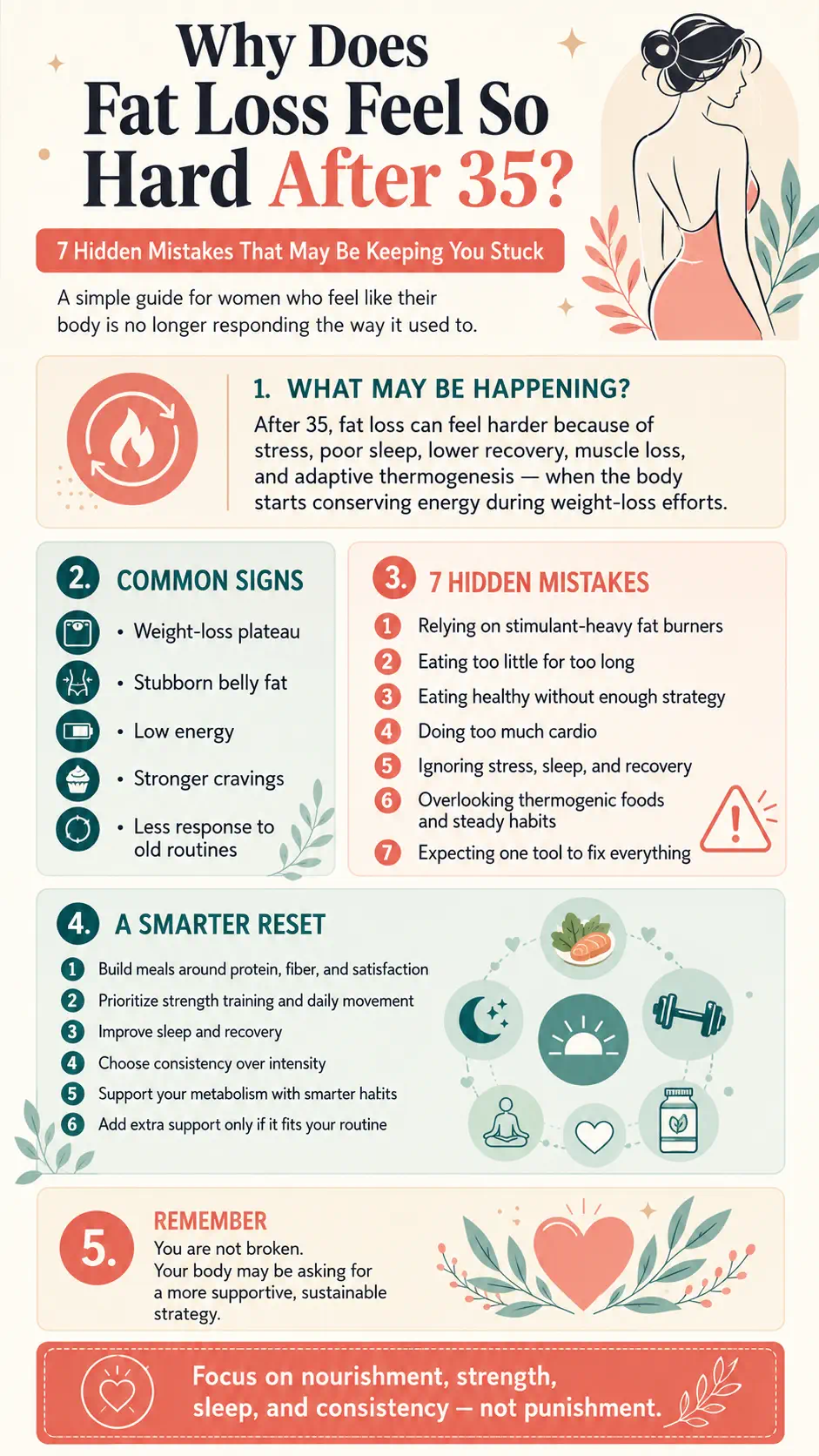
Fat loss often feels harder after 35 because your body may be dealing with changes in recovery, muscle support, stress, sleep, and energy use. The solution is usually not more punishment—it is a smarter plan built around protein intake, strength training, recovery, consistency, and realistic metabolism support.
That matters because many women assume the answer is simply to eat less and exercise more. But when your body is already stressed, depleted, or adapted, that approach can make progress feel even harder.
This article will walk you through what may be happening, why it feels so emotional, and how to support your body in a more sustainable way.
Why Does Fat Loss Change So Much After 35?
Fat loss changes after 35 because the body often responds differently to stress, recovery, sleep, muscle maintenance, and hormonal shifts. What worked in your 20s may not work the same way now, which is why a more strategic approach becomes essential.
This is one reason so many women feel confused. The habits that once produced visible results may now seem weak, slow, or almost useless.
That can create a painful emotional spiral. You try harder, restrict more, and blame yourself, even though the issue may be that your body needs a different kind of support.
Research on why metabolism slows with age according to Harvard Health helps explain why energy use, muscle support, and recovery can change over time.
Instead of seeing your body as a problem, it helps to see it as a system that has changed. Once you respond to those changes intelligently, progress can start to feel possible again.
What Is Adaptive Thermogenesis and Why Does It Matter?
Adaptive thermogenesis is the body’s tendency to reduce energy expenditure during or after weight-loss efforts. In practical terms, that means your body may burn fewer calories than expected, making a weight-loss plateau more likely.
This helps explain why progress can stall even when you feel disciplined. You may notice lower energy, stronger cravings, more hunger, and less response to the same habits that once worked.
Emotionally, this can feel devastating because it makes effort seem invisible. But the problem is often not a lack of willpower—it is a mismatch between your strategy and what your body now requires.
That is why understanding this concept creates hope. Once you know your body may be adapting, you can stop fighting blindly and start building a smarter plan.
Why Does It Feel Like Your Body Is Working Against You?
It feels like your body is working against you because stalled fat loss often affects far more than appearance. It touches confidence, identity, energy, and the private fear that your body no longer responds to your effort.
This pain often shows up in ordinary moments. A tighter waistband. A photo you do not want to look at. A wave of dread before getting dressed. A silent feeling that aging is taking control away from you.
That is why this struggle feels so personal. It is not just about losing weight. It is about wanting to feel light, attractive, comfortable, and powerful in your own skin again.
The good news is that your body is not necessarily betraying you. It may simply be responding to stress, depletion, poor recovery, or outdated strategies—and that means there is room for a better answer.
Mistake #1: Are You Relying on Stimulant-Heavy Fat Burners for Fast Results?
Stimulant-heavy fat burners may create temporary energy, but they often do not solve the deeper reasons progress has stalled. For many women, they can lead to tolerance, sleep disruption, crashes, and a false sense of progress.
At first, these products can feel exciting because they create motion. You feel more alert, maybe sweat more, and assume something powerful is happening.
But more stimulation does not always mean better fat-loss support. If the product mainly pushes your nervous system harder, it may eventually leave you feeling more tired, more dependent, and less able to stay consistent.
That is why many women eventually begin looking for support that feels steadier, gentler, and more compatible with long-term progress.
Mistake #2: Are You Assuming Eating Less Always Leads to More Fat Loss?
Eating less is not always the answer because prolonged restriction can leave the body feeling stressed, depleted, and more resistant to change. In some cases, under-eating contributes to fatigue, cravings, poor recovery, and slower progress.
This mistake is common because it sounds logical. If weight loss requires a calorie deficit, then a bigger deficit must be better—right?
Not always. When your body senses ongoing scarcity, it may become more protective, not more cooperative. That can make your efforts feel punishing and emotionally exhausting.
A more sustainable approach often works better: enough nourishment, smarter meal structure, and consistency instead of constant deprivation.
Mistake #3: Are You Eating “Healthy” Without Eating Strategically?
Eating “healthy” is not enough if your meals do not support satiety, recovery, and steady energy. A better strategy includes protein for fat loss, fiber, balance, and meals that leave you feeling satisfied rather than deprived.
Many women choose foods that sound virtuous but do not actually support their goals. A salad, smoothie, or low-fat snack can still leave you hungry, under-fueled, or prone to cravings later.
That is why meal structure matters. When meals include protein, fiber, and enough substance to create stability, the body often responds better over time.
This shift is powerful because it replaces guilt-based eating with support-based eating. You stop asking whether food is “good” and start asking whether it actually helps your body function well.
Mistake #4: Are You Doing Too Much Cardio and Not Enough Strength Training?
Too much cardio can backfire when it leaves you exhausted, under-recovered, or struggling to maintain muscle. For many women, strength training for women over 35 is a more effective part of a long-term metabolic strategy.
Cardio has a place, but it is often overused as the main answer. When every workout feels like punishment, your body may feel more drained than supported.
Strength training, walking, and moderate cardio often create a better balance. This combination can support daily energy, muscle retention, and a more sustainable fat-loss environment, especially when aligned with CDC guidance on strength training and weekly physical activity for adults.
The goal is not to do less out of laziness. The goal is to do what actually helps your body respond.
Mistake #5: Are You Ignoring the Impact of Stress, Sleep, and Recovery?
Stress, sleep, and recovery directly affect how your body feels, functions, and responds to fat-loss efforts. If these areas are neglected, even a “perfect” diet or workout plan may feel less effective.
This is one of the most overlooked reasons women feel stuck. You may be following a plan, but if your sleep is poor and your nervous system is constantly overloaded, your body may stay in a more defensive state.
That can influence appetite, cravings, energy, motivation, and how well you recover from exercise. It can also make everything feel harder than it should.
Menopause-related shifts can also play a role, and Mayo Clinic’s explanation of menopause and weight gain is a strong resource for understanding why body composition and fat distribution may change during this stage of life.
When recovery improves, many women feel a surprising shift: less chaos, more stability, and a body that finally seems more willing to respond.
Mistake #6: Are You Overlooking Thermogenic Foods and Gentle Daily Support?
Many women overlook the small, supportive habits that help create a better fat-loss environment over time. Thermogenic foods, daily movement, hydration, meal consistency, and steady routines may not feel dramatic, but they often matter more than people realize.
This matters because people often swing between extremes. They either try harsh solutions or give up entirely, missing the middle ground where sustainable progress actually lives.
Small supportive choices can reduce chaos and help your body feel more stable. Over time, that stability often matters more than bursts of intensity.
This is where a gentler mindset becomes powerful. Instead of trying to force results, you begin building conditions that make results more likely.
Mistake #7: Are You Expecting One Tool to Solve a Full-Body Problem?
No single supplement, workout, or food can do the work of a complete system. Sustainable progress usually comes from alignment across nutrition, training, sleep, stress, and consistency.
This mistake is easy to make because when you feel desperate, you want one clear answer. One thing to buy. One thing to follow. One thing to fix it all.
But the body is more complex than that. When several small problems are working together, the solution also needs to work together.
That does not make progress impossible. It simply means the most effective path is usually supportive, layered, and realistic.
How Can You Break a Stubborn Plateau Step by Step?
You can break a stubborn plateau by shifting from pressure to support. The most effective approach usually combines strategic eating, strength training, better recovery, daily consistency, and carefully chosen support tools.
Step 1: Audit your current routine honestly.
Look at whether your routine feels sustainable or punishing. If you feel exhausted, hungry, and emotionally drained, your current approach may be too aggressive.
Step 2: Build meals around protein, fiber, and satisfaction.
This supports steadier energy and reduces the cycle of restriction followed by overeating. Balanced meals help your body feel safer and more stable.
Step 3: Prioritize resistance training and daily movement.
Walking, resistance training, and moderate cardio often work better together than relying on endless high-intensity sessions.
Step 4: Improve sleep and recovery.
A better-rested body is often a more responsive body. Recovery is part of the strategy, not a reward after the strategy.
Step 5: Choose consistency over intensity.
The body tends to respond better to steady support than to dramatic swings between perfection and burnout.
Step 6: Add extra support carefully if it fits your routine.
Some women explore added metabolism support only after the basics are in place, which often leads to more realistic expectations and better long-term outcomes.
What Should You Look for in Metabolism Support If You Want Extra Help?
The best support option is one that fits your body, your routine, and your long-term goals without relying only on harsh stimulation. A good option should complement healthy habits, not pretend to replace them.
This matters because many women are not looking for a miracle. They are looking for something that helps them feel supported rather than pushed harder.
Look for something that feels realistic, sustainable, and compatible with how you want to care for your body. That often means moving away from “extreme” promises and toward products that fit a broader wellness strategy.
That is one reason some women become curious about options like Citrus Burn. Not as a shortcut, but as a possible layer of support within a more balanced natural metabolism support routine.
FAQ
Why is it so hard for me to lose weight after 35 even when I’m eating better?
Fat loss can feel harder after 35 because your body may be dealing with changes in recovery, muscle support, stress, sleep, and energy use. Even when you are eating better, progress may slow if your body has adapted to stress, restriction, or inconsistent habits.
What does adaptive thermogenesis actually mean in simple words?
Adaptive thermogenesis means your body may start burning fewer calories during or after weight-loss efforts. In simple terms, it is your body’s way of conserving energy, which can make fat loss feel slower and more frustrating.
Why am I barely losing weight when I feel like I’m doing everything right?
You may be doing many things right, but your strategy might not match what your body needs right now. Stress, poor recovery, low protein intake, under-eating, and too much cardio can all make progress feel stalled.
Why does my belly fat seem harder to lose than it used to be?
Belly fat can feel harder to lose because stress, sleep problems, hormonal shifts, and lower recovery can all affect how your body stores and releases fat. This does not mean you are stuck forever, but it may mean you need a more supportive and strategic plan.
Can eating too little actually make fat loss harder for me?
Yes, eating too little for too long can make fat loss feel harder by increasing fatigue, cravings, and metabolic resistance to change. A body that feels constantly deprived may become more protective instead of more responsive.
Is too much cardio one reason my body feels stuck?
Yes, too much cardio can become a problem if it leaves you exhausted, under-recovered, or struggling to maintain muscle. A more balanced routine with strength training, walking, and moderate cardio is often easier for the body to respond to.
How much does stress and lack of sleep really affect weight loss?
Stress and poor sleep can have a major effect on fat loss because they influence energy, hunger, cravings, mood, and recovery. Even a strong nutrition plan can feel less effective when your body is chronically tired or overloaded.
What should I focus on first if I want to start losing weight again?
Start by focusing on the basics that support your body the most: protein-rich meals, strength training, daily movement, better sleep, and consistency. Those changes often create a stronger foundation than jumping straight into another extreme diet or intense supplement.
What kind of workout is usually better for women over 35?
A balanced routine is usually better than an extreme one. Strength training, walking, moderate cardio, and proper recovery often work better together than relying only on long, exhausting cardio sessions.
Do I need to stop eating carbs if I want to lose weight?
No, most women do not need to completely remove carbs to lose weight. What matters more is overall meal balance, protein intake, portion awareness, food quality, and consistency over time.
Are fat burners actually helpful if my metabolism feels slow?
Some products may offer temporary support, but stimulant-heavy fat burners often do not solve the deeper reasons progress has stalled. A better option is usually a broader strategy that supports metabolism through food, movement, recovery, and carefully chosen tools. You can also read Citrus Burn reviews for women 35 and whether it actually works for a closer look at how some women evaluate this kind of support.
What should I look for in a metabolism support supplement?
Look for a supplement that fits your routine, does not rely only on harsh stimulation, and works alongside healthy habits instead of pretending to replace them. The best support tools feel sustainable, realistic, and aligned with your long-term goals, especially if you are comparing options like Citrus Burn for women 35 for weight loss, energy, and a fit-looking body.
Where would Citrus Burn fit into a plan like this?
Citrus Burn may fit in as an added layer of support within a broader routine that includes better meals, exercise, sleep, and consistency. It makes the most sense when viewed as a complement to healthy habits rather than a shortcut, and you can review the Citrus Burn pricing guide for women aged 35+ if cost and value are part of your decision.
How long does it usually take to get past a weight-loss plateau?
It depends on the person, but many women start noticing better momentum after several weeks of more supportive and sustainable habits. The goal is not instant change, but steady progress that your body can actually maintain.
When should I talk to a doctor instead of trying to figure this out on my own?
You should talk to a doctor or qualified healthcare professional if you have persistent fatigue, rapid weight changes, hormone concerns, medication use, or any medical condition. That is especially important before making major changes to diet, exercise, or supplement use.
What Should You Do Next If You’re Tired of Feeling Stuck?
Your next step is not to punish your body harder—it is to support it more intelligently. When you combine nourishment, training, recovery, and realistic support, progress often begins to feel possible again.
If you have been carrying frustration, shame, or quiet disappointment, pause here and remember this: you are not broken. Your body may simply need a different conversation than the one diet culture taught you to have.
Start with the basics that matter most. Build meals that truly support you. Move in ways you can recover from. Sleep like it counts. Lower the pressure to be perfect. Choose support tools carefully.
And if you want to explore an option that may fit into a gentler, more supportive routine, you can take a closer look here:
Because sometimes hope does not return through force. Sometimes it returns the moment you finally understand what your body may have been asking for all along.


Comments
Post a Comment