What Men Need Emotionally: 9 Quiet Needs
9 Quiet Needs
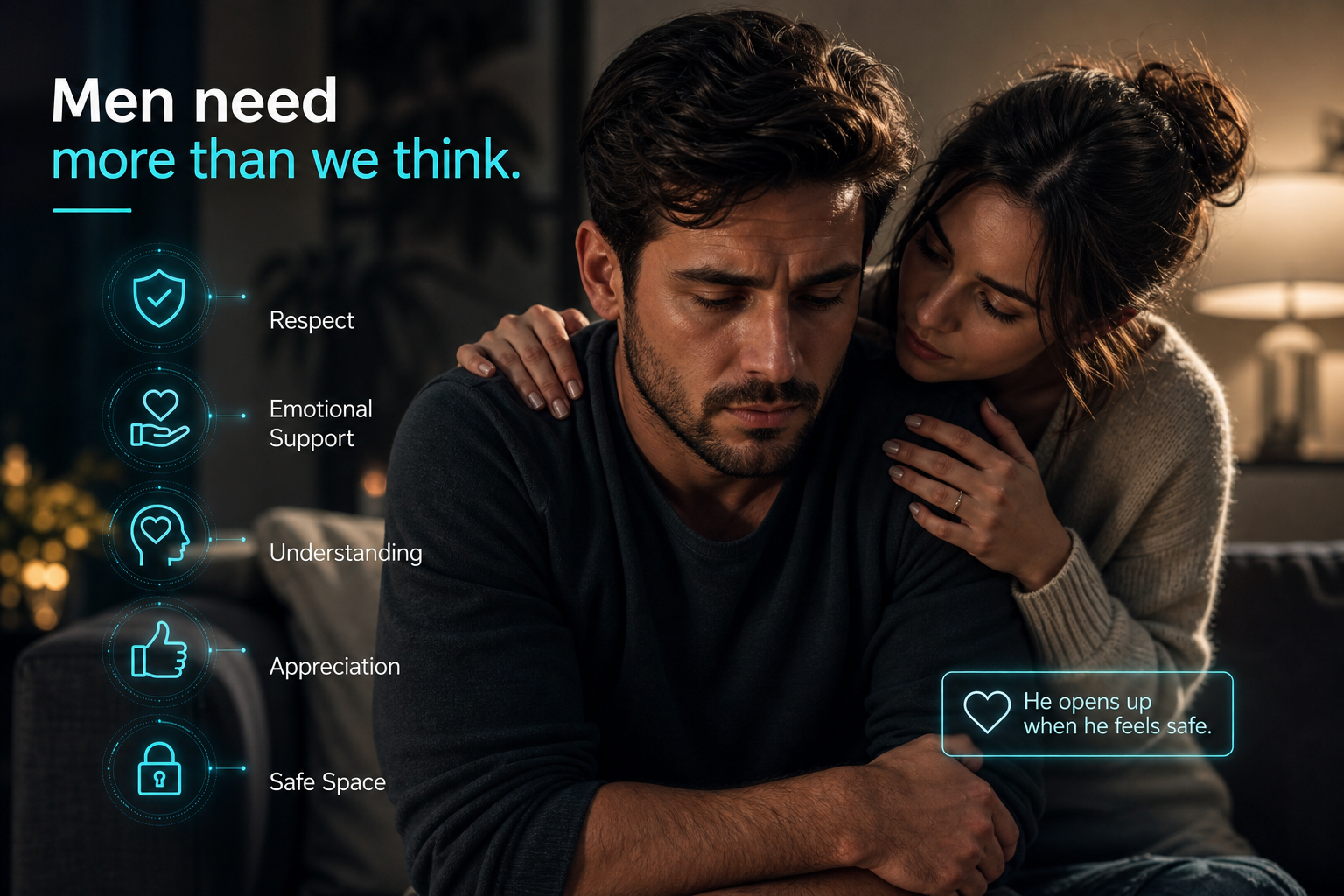
Men often need respect, trust, appreciation, emotional safety, physical affection, space to process, and the feeling of being actively chosen in the relationship.
You love him. You show up. You try. And still, something goes quiet between you.
He pulls back. He gets distant. He says he’s fine, but something underneath clearly is not. That can leave you feeling confused, hurt, and stuck trying to decode what is really going on.
In many relationships, the issue is not a lack of love. It is a lack of translation.
What men need emotionally is real, specific, and often difficult for them to say out loud. Many men were never taught how to name emotional needs clearly, ask for them directly, or feel safe expressing them without shame. So those needs often come out indirectly through silence, irritability, distance, or shutdown.
This article by understandingman.com explains nine quiet emotional needs many men have in relationships, why those needs are often missed, and how to respond in ways that build trust, closeness, and emotional safety.
Article Navigation
- Why Do Men Struggle to Say What They Need Emotionally?
- What Emotional Need Makes Many Men Feel Most Loved?
- Why Do Men Need to Feel Trusted and Competent?
- Why Does Appreciation Matter So Much to Men?
- Why Do Men Go Quiet Instead of Talking Right Away?
- Why Does Giving Him Space Sometimes Help the Relationship?
- What Makes a Man Feel Emotionally Safe Enough to Open Up?
- Why Do Men Want to Be Heard Without Being Fixed?
- Why Is Physical Affection So Emotionally Important to Many Men?
- Why Do Men Need to Feel Chosen, Not Just Needed?
- How Can You Start Meeting These Emotional Needs Today?
- FAQ
- What Men Need Emotionally in a Relationship
💡 Relationship Clarity
Not sure how he really feels right now?
Why Do Men Struggle to Say What They Need Emotionally?
Many men struggle to say what they need emotionally because vulnerability has often been taught to them as weakness, risk, or loss of respect.
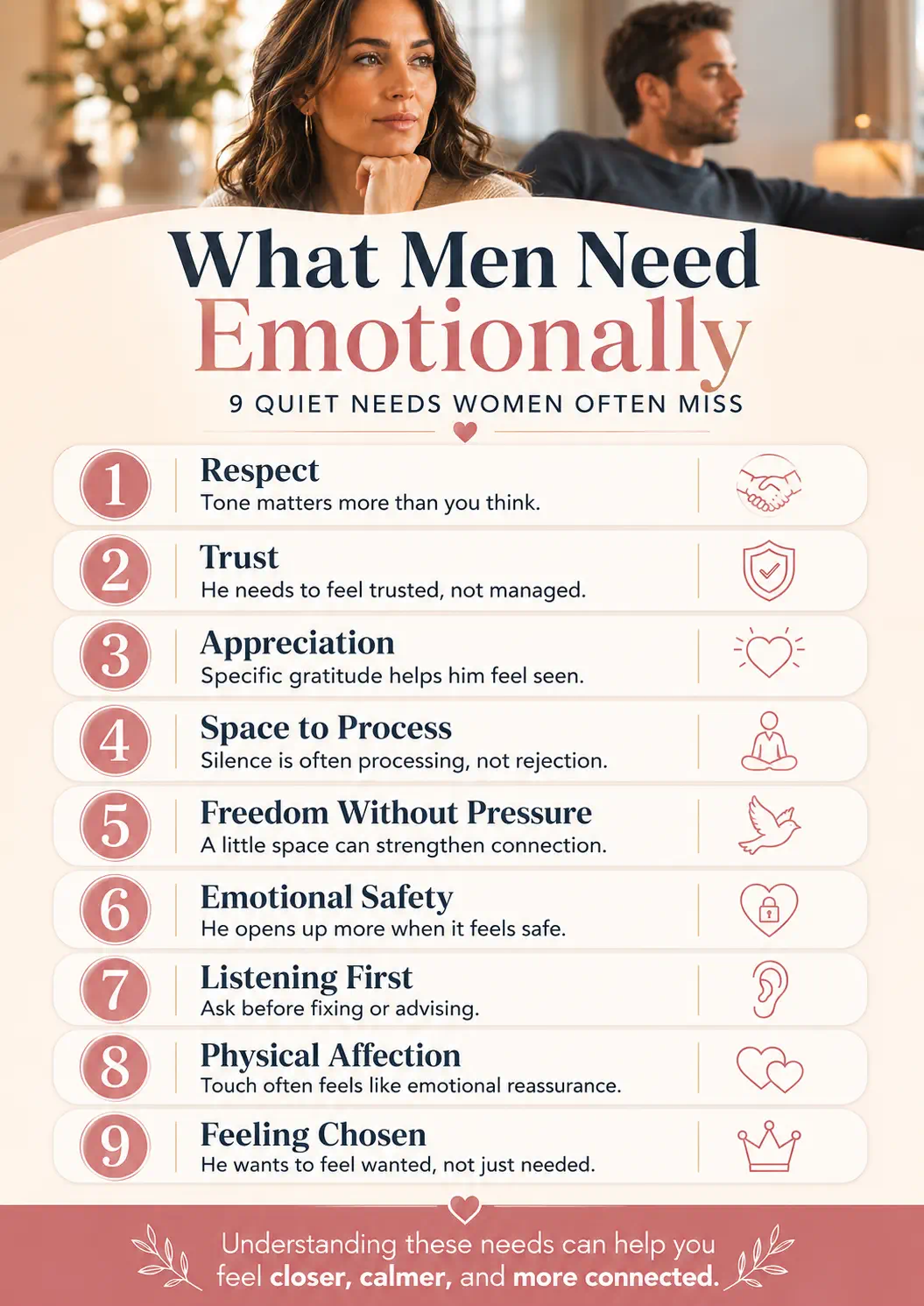
That pattern often starts early. In many Western cultures, boys are rewarded for being tough, self-contained, and emotionally controlled. Research on male help-seeking shows that men who strongly internalize traditional beliefs about toughness and self-reliance are less likely to disclose distress or seek support, even from people they trust. Broader psychological discussion around how men are socialized to suppress emotion helps explain why this pattern can persist into adult relationships.
For many men, silence is not the absence of feeling. It is the form their self-protection takes.
This can show up differently depending on personality, family system, age, and culture. Some men are more emotionally aware than others. Some can talk, but only after they have processed internally. Others still fear that if they open up, they will be judged, managed, or seen differently.
That does not mean women should have to guess forever. It means many men communicate emotional needs indirectly, especially when they do not yet have the language to express them well. So when a man becomes quiet, irritable, or distant, it is often worth asking whether an emotional need is going unmet underneath the surface.
Quotable takeaway: Men often do not hide emotion because they feel nothing. They hide it because expressing it has felt costly.
What Emotional Need Makes Many Men Feel Most Loved?
For many men, respect is one of the emotional experiences most closely tied to feeling loved.
Being spoken to with care, having his opinions taken seriously, and not being belittled or corrected in front of others often register as emotional safety, not just good manners. For many men, respect is not separate from love. It is one of the main ways love is felt.
When that need goes unmet, he may not say, “I feel disrespected.” More often, he goes quiet, becomes defensive, or stops offering parts of himself that used to come naturally.
John Gottman’s work is useful here. The Gottman framework on why contempt is so damaging in relationships helps explain why sarcasm, mockery, eye-rolling, and dismissive tone can slowly destroy trust and closeness. Many men experience contempt as especially painful because it attacks both emotional safety and personal value at the same time.
There is a real difference between honest feedback and contempt. Honest feedback can build trust. Contempt slowly erodes it.
If he gets quiet after being corrected in public, stops volunteering opinions, or disengages from conversations he used to care about, the issue may not be stubbornness. It may be that he no longer feels emotionally respected.
Quotable takeaway: For many men, respect is not separate from love. It is the language love arrives in.
Why Do Men Need to Feel Trusted and Competent?
Many men need to feel trusted and competent because being constantly second-guessed can feel like emotional rejection, not just disagreement.
When a man is micromanaged, overdirected, talked over, or routinely corrected in a controlling tone, it can land as a message that says, “I do not trust your judgment.” That feeling affects more than confidence. It affects connection.
For many men, competence is tied to emotional dignity. This does not mean they need to be right all the time or immune from feedback. It means they need to feel like an equal adult in the relationship, not a problem to be managed.
Often, the difference is not the content of what is said but how it is said. “Here’s another angle you might consider” feels very different from “No, do it this way.” One invites partnership. The other can feel like supervision.
Healthy relationships include feedback, influence, and shared decision-making. Trusting his competence does not mean silence when something matters. It means communicating in a way that preserves mutual respect rather than unintentionally undermining it.
Quotable takeaway: Men often do not need less feedback. They need feedback that still leaves dignity intact.
Why Does Appreciation Matter So Much to Men?
Appreciation matters to many men because specific, unprompted acknowledgment helps them feel seen, not just useful.
A generic “thanks” is nice, but what often goes deeper is clear recognition of something he did, how he showed up, or the way he handled a moment. Many men are used to being valued for what they provide, fix, or carry. Appreciation reminds him that you notice the person, not only the function.
That is why a sentence like, “I noticed how calm you stayed in that conversation this week. That really made a difference,” often lands much more powerfully than a vague compliment. It communicates attention. It tells him he is visible to you.
This is one of the simplest ways to strengthen emotional connection because it meets more than one need at once. Appreciation can reinforce respect, increase emotional safety, and reduce the quiet resentment that grows when someone feels taken for granted.
For practical examples of the kinds of affectionate actions that register most strongly, see What Kind of Affection Do Men Actually Want From a Partner? 4 Ways Men Feel Most Loved.
Quotable takeaway: Specific appreciation tells a man he is not only useful. He is seen.
Why Do Men Go Quiet Instead of Talking Right Away?
Many men go quiet instead of talking right away because silence is often how they process emotion before they can put it into words.
This is one of the most misunderstood patterns in relationships. When a man becomes quiet after conflict, stress, or disappointment, many women understandably read it as rejection or punishment. Sometimes it is withdrawal. But often it is internal processing.
Research on demand-withdraw patterns in couples suggests that one partner often pushes for immediate discussion while the other retreats under pressure. In many heterosexual relationships, men are more likely to take the withdrawing role when they feel overwhelmed, flooded, or unsure what they feel.
In those moments, he may not be refusing connection. He may simply not have words yet.
That does not make endless shutdown healthy. But it does change how short-term silence should be interpreted. If you understand his quiet as a temporary regulation strategy rather than instant proof that he does not care, your response becomes more grounded and less reactive.
A helpful response sounds like this: “I’m here when you’re ready. No rush.” That gives him a door back into connection without turning the moment into another pressure point.
Quotable takeaway: Silence is not always distance. Sometimes it is unfinished emotion.
Why Does Giving Him Space Sometimes Help the Relationship?
Giving him space sometimes helps the relationship because many men reconnect better when they feel trusted to process without pressure.
This idea can feel counterintuitive, especially when distance already feels painful. But for many men, autonomy is part of emotional safety. When every need for time alone becomes an argument, suspicion, or emotional emergency, space starts to feel dangerous. That is when a man may pull away more defensively.
Healthy space and unhealthy withdrawal are not the same thing.
Healthy space is temporary and usually comes with some sign of care, reassurance, or return. Unhealthy withdrawal becomes a repeating pattern of avoidance, emotional unavailability, and refusal to repair. Women should not be expected to excuse chronic disconnection in the name of “he just needs space.”
But in a good relationship, giving space freely can communicate trust. It says, “I am not panicking just because you need a moment.” That kind of trust often makes it easier for him to come back open instead of guarded.
Quotable takeaway: Space does not always create distance. Pressure often does.
What Makes a Man Feel Emotionally Safe Enough to Open Up?
A man usually feels emotionally safe enough to open up when he expects curiosity, steadiness, and non-judgment instead of criticism, alarm, or instant fixing.
Men do not usually become vulnerable because they are asked once. They become vulnerable because the environment feels safe enough to risk it.
What happens after he shares matters enormously. If he opens up and the response is correction, panic, interrogation, or visible disappointment, he often learns that vulnerability comes with emotional cost. The next time, he is less likely to go there.
This is why many women feel frustrated by a pattern that goes like this: he says something real, she responds with solutions, and then he shuts down. Her intention is care. His experience may be that sharing led to being managed.
Emotional safety is built through repeated moments of calm response. Simple phrases like, “That sounds frustrating. Tell me more,” often do more to build trust than any perfectly designed advice.
For concrete steps you can use today, a short practical guide on how to create emotional safety in your relationship can be a helpful starting point.
Quotable takeaway: Men open up less because they are told to and more because it feels safe to.
Why Do Men Want to Be Heard Without Being Fixed?
Many men want to be heard without being fixed because listening without immediately solving the problem communicates both care and trust.
Many women show love by helping. That instinct is generous. But in some moments, what a man needs most is not strategy. It is space to be fully heard before the conversation moves into problem-solving.
Being listened to without immediate analysis or correction can feel deeply validating. It says, “I am with you,” and also, “I believe you can handle this.” For many men, that combination is emotionally powerful.
A simple question can change the whole conversation: “Do you want to think it through together, or do you just need to vent?” That question removes guesswork and lets him define the kind of support he wants.
Another strong response is, “That sounds really hard. I’m here.” It keeps the focus on connection instead of control.
Asking what support he wants is a small shift with a big effect. It helps him feel respected rather than managed, which is often exactly what he needs in vulnerable moments.
Quotable takeaway: Listening without fixing can be one of the clearest forms of respect.
Why Is Physical Affection So Emotionally Important to Many Men?
Physical affection is emotionally important to many men because touch often communicates reassurance, love, and connection more clearly than words.
For many men, affectionate touch is not only physical. It is emotional language. A hand on the arm, sitting close on the couch, a long hug, or affectionate initiation can quietly say, “I want you near,” “You matter to me,” and “We are okay.”
A study on affectionate touch and bonding links warm, consensual touch to lower stress, stronger bonding, and greater relationship security. A more accessible overview of how affectionate touch supports emotional connection and stress relief also helps reinforce why touch can matter so much in close relationships.
This becomes especially important in long-term relationships, where affectionate touch can fade while routines and responsibilities take over. Some men do not complain when that happens. They simply begin to feel less connected, less wanted, and less emotionally anchored.
For a practical breakdown of the kinds of affectionate behaviors that often register as “love” for men, see 7 Types of Affection Men Need to Feel Loved.
Quotable takeaway: For many men, touch is not extra. It is evidence of connection.
Why Do Men Need to Feel Chosen, Not Just Needed?
Many men need to feel chosen, not just needed, because being actively wanted creates emotional closeness in a way routine dependence does not.
This is one of the quietest but most powerful emotional needs many men carry. He may know you rely on him. He may know you appreciate what he does. But that is not always the same as feeling genuinely desired, delighted in, or personally wanted.
This often shows up in very small moments: a warm text during the day, affectionate initiation, an unprompted compliment, visible enthusiasm when he walks in the room, or any gesture that says, “I still turn toward you on purpose.”
Many men do not have neat language for this need. They may describe it as wanting to feel seen, desired, valued, or remembered. Underneath those words is often the same longing: not just to belong in your life, but to feel that your heart still chooses them with intention.
This matters even more in long-term relationships because novelty fades naturally. Intention does not. The gestures that once happened automatically usually need to become deliberate. That deliberateness is not less romantic. It is often more meaningful.
Quotable takeaway: Being needed feels practical. Being chosen feels personal.
How Can You Start Meeting These Emotional Needs Today?
You can start meeting these emotional needs today by using more specific appreciation, calmer responses, respectful language, and clearer emotional support.
These needs do not require becoming a different person or carrying the full emotional burden of the relationship alone. They require intention, not perfection.
A few phrases that many men experience as grounding, respectful, and emotionally safe are:
- “I hear you. That makes sense.”
- “I trust your judgment on this.”
- “I appreciate what you did, especially the way you handled that.”
- “Do you want space or company right now?”
- “I’m not trying to fix it. I just want to understand.”
The words matter, but tone matters just as much. Even the right sentence can miss if it is delivered with contempt, sarcasm, urgency, or hidden resentment. Emotional safety is built as much by what is absent as by what is present.
The simplest daily habit is this: offer one specific, genuine acknowledgment every day. Not flattery. Not performance praise. Recognition. Notice how he showed up, what he carried, how he handled something, or who he was in a moment.
Done consistently, that one habit touches appreciation, respect, emotional safety, and feeling chosen at the same time.
If you want to go deeper into each of these patterns and learn how to translate them into everyday habits, a useful summary of men’s unspoken needs is available in Understanding Men's Needs in a Relationship: What He Can't Say.
Quotable takeaway: The most practical place to start is one specific acknowledgment a day.
❤️ Practical Next Steps
Want a simple framework you can start using right away?
FAQ
What Do Men Need Emotionally in a Relationship?
Men often need respect, trust, appreciation, emotional safety, physical affection, and the feeling of being actively chosen.
Many men want to feel safe enough to open up without being judged, corrected, or managed. They also want to feel valued for who they are, not only for what they do. While every man is different, these needs show up often in healthy long-term connection. For a deeper look at these patterns, read men’s unspoken needs in a relationship.
💡 Want More Relationship Clarity?
Still unsure what he feels but doesn’t say out loud?
Why Do Men Go Quiet When They Are Upset?
Men often go quiet when they are upset because they are trying to process emotion internally before putting it into words.
Silence is not always rejection or punishment. In many cases, it is a way of regulating stress, overwhelm, or emotional confusion. That said, short-term processing is different from chronic emotional withdrawal, and the pattern over time matters.
💬 Need Help Understanding His Distance?
Confused about why he gets quiet or pulls away?
Do Men Need Respect More Than Love?
For many men, respect is one of the main ways love is emotionally felt.
That does not mean men do not need tenderness, reassurance, or affection. It means that when a man feels consistently dismissed, mocked, or belittled, he may stop feeling loved even if love is being expressed in other ways. In many relationships, respect and love are deeply connected.
How Can I Make a Man Feel Emotionally Safe?
You can make a man feel emotionally safe by responding with calm curiosity, steadiness, and non-judgment when he shares something vulnerable.
That usually means listening before fixing, asking before advising, and staying respectful even during conflict. Simple responses like “That sounds hard” or “Tell me more” often do more to build safety than immediate solutions do.
❤️ Want Practical Steps You Can Use Today?
Need a simple framework to build connection and momentum?
Why Does My Boyfriend Pull Away When Things Get Emotional?
A boyfriend often pulls away when things get emotional because he feels overwhelmed, flooded, unsure how to express himself, or afraid of being misunderstood.
Pulling away does not always mean he cares less. Sometimes it means he does not have the language, regulation, or confidence to stay present in the moment. Healthy space can help, but repeated avoidance without repair is a different issue.
🔥 Want to Understand What Builds Attraction?
Looking for deeper insight into emotional pull and connection?
What Kind of Appreciation Do Men Want Most?
Many men respond best to specific, sincere appreciation that shows you noticed how they showed up, what they handled well, or who they were in a moment.
Generic praise is fine, but specific acknowledgment usually lands more deeply. A sentence like “I really appreciated how steady you were during that conversation” often means more than a vague compliment because it makes him feel truly seen. For more examples, read what kind of affection men actually want from a partner.
Do Men Want Advice or Just Someone to Listen?
Many men want someone to listen first and offer advice only if they ask for it.
Being heard without immediately being fixed can feel deeply respectful and supportive. A helpful question is, “Do you want to vent, or do you want help thinking it through?” That gives him space to define the kind of support he wants.
Why Is Physical Affection So Important to Men?
Physical affection is important to many men because touch often communicates love, reassurance, and emotional connection more clearly than words.
A hug, a hand on the arm, sitting close, or affectionate initiation can all signal warmth and closeness. For many men, affectionate touch is not just physical. It is one of the clearest ways they feel emotionally connected in the relationship. For a practical breakdown, see 7 types of affection men need to feel loved.
Do Men Need Space to Feel Close?
Many men do need occasional space to feel close because time to process can help them return more open and connected.
Healthy space is not the same as emotional avoidance. Space can support closeness when it is temporary, respectful, and followed by reconnection. The key difference is whether he comes back and repairs, or uses distance as a permanent escape.
How Do I Know if a Man Feels Unseen in the Relationship?
A man may feel unseen in the relationship if he becomes quieter, less expressive, less engaged, or stops bringing his inner world into the relationship.
He may also seem emotionally flat, less affectionate, or less willing to initiate conversation. Often, this happens when he feels taken for granted, chronically corrected, or valued only for what he provides instead of for who he is.
Do Men Want to Feel Chosen or Just Needed?
Many men want to feel chosen, not just needed, because being actively wanted creates a deeper sense of emotional closeness.
Being needed can feel practical. Being chosen feels personal. Small gestures like affectionate initiation, warm messages, visible enthusiasm, and unprompted compliments often matter because they communicate, “I still want you, not just your role in my life.”
✨ Want to Rebuild Desire and Emotional Pull?
Ready to create more attraction and deeper connection with him?
What Should I Say When He Shuts Down Emotionally?
When he shuts down emotionally, the best thing to say is often something calm and low-pressure like, “I’m here when you’re ready.”
That kind of response leaves the door open without adding pressure. It helps him feel supported instead of cornered. If shutdown becomes a long-term pattern without repair, though, the relationship may need a more direct conversation about communication and emotional availability.
Can a Relationship Improve if a Man Struggles to Express His Feelings?
A relationship can improve if a man struggles to express his feelings, but only if both people are willing to build better emotional communication over time.
Understanding his needs can help, but it should not become one-sided emotional labor. Growth happens best when one partner creates safety and the other partner gradually takes more responsibility for naming feelings, communicating needs, and staying engaged.
🔥 Attraction Support
Ready to understand what builds attraction and emotional connection over time?
What Men Need Emotionally in a Relationship
What men need emotionally in a relationship is to feel respected, trusted, appreciated, emotionally safe, physically connected, and actively chosen.
That does not mean every man is the same. It does not mean women should do all the emotional work. And it does not mean understanding him excuses poor communication or unhealthy behavior.
But in a healthy relationship, understanding these needs changes the quality of connection. You stop interpreting every silence the same way. You start noticing the difference between overwhelm and indifference, between advice and support, between pressure and safety.
That shift matters because the gap between two people is often not about whether love exists. It is about whether love is being felt in the way it is most needed.
✨ Next Step
If you want more support applying this in real life,
UnderstandingMan.com was built for exactly this reason: to help women understand the male emotional experience with more empathy, nuance, and clarity. Not to blame women. Not to excuse men from communicating. But to bridge the gap that so many couples feel and struggle to explain.
If you'd like a short, accessible read on other therapists' perspectives about what men need in relationships, this article on men's surprising relationship needs offers additional practical insight and examples.


Comments
Post a Comment