9 Relationship Needs Men Will Never Tell You

Needs Men Will Never Tell You..
You love him. You show up. You try. And still, something goes quiet between you.
He pulls back. He gets distant. He says he is “fine,” but something in the relationship feels different. You can sense the emotional shift, but you may not know what caused it or how to respond without making things worse.
This plays out in thousands of relationships every day. And most of the time, the problem is not a lack of love. It is a lack of understanding.
What men need emotionally is real, specific, and often unspoken. Not because men do not have emotional needs, but because many men were never taught how to name those needs clearly. They may feel them deeply, but instead of saying, “I need appreciation,” “I need respect,” or “I need space to process,” they go quiet, pull away, become irritable, or shut down.
That is where many women get confused.
You may think he is rejecting you. He may actually feel overwhelmed. You may think he does not care. He may not know how to express what he needs without feeling weak, criticized, or exposed.
Understanding what men need emotionally does not mean ignoring your own needs. It does not mean excusing distance, disrespect, or emotional unavailability. It means learning how to read the emotional signals beneath the behavior so you can respond with more clarity instead of guessing.
The nine emotional needs below show up consistently in research, therapy conversations, and real relationships. When you understand them, you stop chasing surface behavior and start seeing what is really happening underneath.
Article Navigation: What You’ll Learn About Men’s Emotional Needs
This article by understandingman.com explains the emotional needs men often struggle to say out loud, including respect, trust, appreciation, emotional safety, space, physical closeness, and feeling genuinely chosen.
- What Do Men Need Emotionally in a Relationship?
- Why Do Men Rarely Say What They Need Emotionally?
- What Are the Signs His Emotional Needs Are Not Being Met?
- Why Do Men Need Respect to Feel Emotionally Safe?
- Why Do Men Need to Feel Trusted Instead of Micromanaged?
- Why Do Men Need Specific Appreciation?
- Why Do Men Go Quiet When They Are Stressed or Upset?
- Is His Silence Processing or Emotional Avoidance?
- Why Do Men Need Space Without Feeling Punished for It?
- Why Do Men Need Emotional Safety Before They Open Up?
- Why Do Men Want to Be Heard Without Being Fixed?
- Why Do Men Need Physical Closeness to Feel Loved?
- Why Do Men Need to Feel Genuinely Chosen?
- Does Understanding His Emotional Needs Mean Ignoring Yours?
- What Should You Not Do When He Seems Emotionally Distant?
- How Can You Start Meeting a Man’s Emotional Needs Today?
- FAQ
- The Gap Was Never Love
Key Takeaways About What Men Need Emotionally
Men often need respect, trust, appreciation, space to process, emotional safety, physical closeness, and the feeling that they are genuinely chosen by their partner.
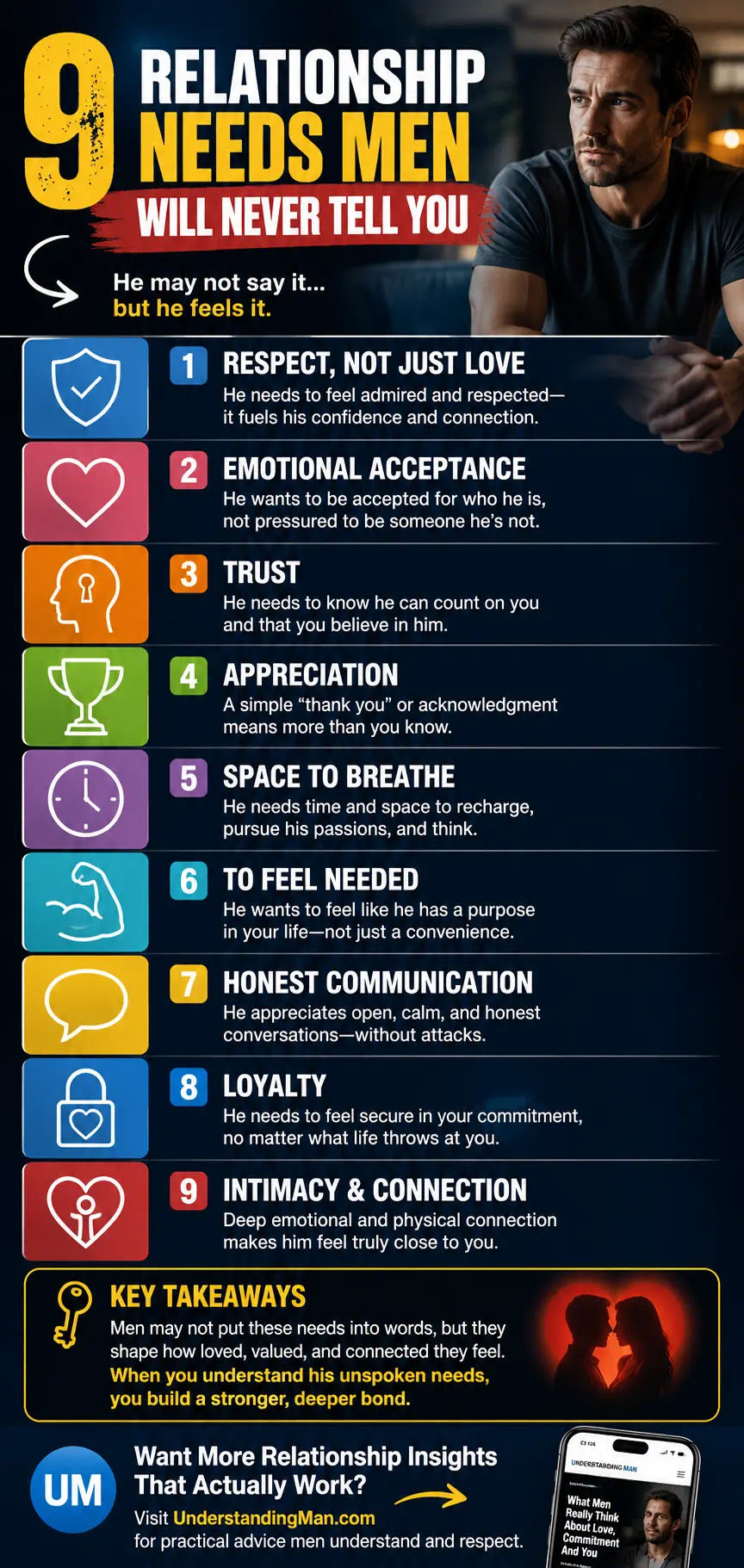
- Many men do not clearly say what they need emotionally because vulnerability can feel risky.
- Silence does not always mean rejection; sometimes it means he is trying to process what he feels.
- Respect, appreciation, and trust often help men feel emotionally safe in a relationship.
- Physical closeness can be an emotional language for men, not just a sign of desire.
- Understanding his emotional needs should never mean ignoring your own needs.
What Do Men Need Emotionally in a Relationship?
In simple terms, men need to feel respected, trusted, appreciated, emotionally safe, physically connected, and genuinely chosen by the woman they love.
Men often need respect, trust, appreciation, space to process, emotional safety, physical closeness, and the feeling that they are genuinely chosen by their partner.
The challenge is that many men do not ask for these needs directly. Instead, unmet emotional needs often show up as silence, withdrawal, irritability, defensiveness, or emotional distance.
That does not mean every man is the same. Personality, attachment style, age, culture, emotional maturity, and past relationship experiences all matter. But these patterns show up often enough that understanding them can help you respond with more confidence and less confusion.
If you have been wondering why he feels distant even when nothing obvious happened, the answer may not be that he stopped caring. It may be that one of his emotional needs has gone unnamed for too long.
Why Do Men Rarely Say What They Need Emotionally?
Many men rarely say what they need emotionally because they were taught that needing support, reassurance, or vulnerability can make them look weak.
Before getting into the list, this context matters.
Many men are taught early in life to be tough, self-reliant, useful, and controlled. They may be praised for handling pressure silently, but criticized or dismissed when they show vulnerability.
Over time, that creates a pattern.
Instead of saying, “I feel hurt,” he may become quiet. Instead of saying, “I feel like I’m failing you,” he may get defensive. Instead of saying, “I need reassurance too,” he may act like nothing bothers him.
Research on male help-seeking consistently shows that men who internalize traditional ideas about toughness and self-reliance are significantly less likely to disclose emotional needs, even to a partner they trust.
Research on men, mental health, and traditional masculine norms also shows that cultural expectations around toughness and self-reliance can discourage men from seeking help or naming emotional struggles clearly.
The fear is not always irrational. Many men have experienced judgment, dismissal, shame, or a loss of respect when they showed vulnerability. So they learn to protect themselves by saying less.
This pattern may look different across generations. Older men may carry more stoicism. Younger men may be somewhat more open to discussing emotional needs, but the barrier is still real.
What matters for you is this: when a man goes quiet, pulls back, or seems irritated for no clear reason, those behaviors may be signals that something emotional is happening beneath the surface. He may not be indifferent. He may simply be communicating in a language that takes some decoding.
💡 Want to understand what he feels but rarely says?
If you are tired of guessing what his silence, distance, or mixed signals mean, take the Devotion Quiz to better understand what may be happening beneath the surface.
Click Here to Take the Devotion QuizWhat Are the Signs His Emotional Needs Are Not Being Met?
Signs his emotional needs may not be met include silence, withdrawal, defensiveness, less affection, emotional distance, and avoiding deeper conversations.
A man may not always say, “I feel unseen,” “I feel criticized,” or “I do not feel emotionally safe.” But his behavior may start to shift.
You may notice that he goes quiet instead of explaining what he feels. He may stop volunteering his opinions. He may become passive in decisions. He may avoid deeper conversations or seem physically present but emotionally distant.
He may become defensive when you ask what is wrong. He may stop initiating affection or connection. He may withdraw after conflict instead of repairing. He may say “nothing” when something clearly feels off.
These signs do not automatically mean he does not love you. They also do not mean you should ignore your own pain. They mean there may be an emotional need in the relationship that is not being named clearly.
The goal is not to diagnose him. The goal is to notice the pattern before it becomes distance neither of you knows how to close.
Why Do Men Need Respect to Feel Emotionally Safe?
Many men need respect to feel emotionally safe because respect communicates that their thoughts, judgment, and presence still matter in the relationship.
For many men, respect is not just a social preference. It functions as emotional currency.
Being spoken to with care, having his opinions taken seriously, and not being corrected or embarrassed in front of others can feel deeply validating. To him, respect may communicate love in a way that words alone do not.
This does not mean you have to agree with everything he says. It does not mean avoiding hard conversations. It means the way the conversation happens matters.
There is a major difference between saying, “I see your point, but I look at it differently,” and saying, “That makes no sense. Why would you do it like that?”
One invites connection. The other can feel like contempt.
John Gottman’s work on contempt is worth knowing here. Gottman identified contempt, including sarcasm, eye-rolling, mocking, and dismissive tone, as one of the strongest predictors of relationship breakdown. Contempt does not just communicate disagreement. It communicates disgust or superiority.
The Gottman Institute explains that contempt is one of the most destructive relationship patterns because it communicates disrespect, superiority, and emotional dismissal instead of connection.
For many men, that cuts especially deep because it attacks the sense of competence and value they need to feel emotionally safe in a relationship.
The line between honest feedback and contempt is real. And crossing it repeatedly creates emotional distance over time.
If his respect need is unmet, he may go quiet after being corrected in public. He may stop offering opinions. He may withdraw from decisions he used to care about. He may say, “Do whatever you want,” not because he has no thoughts, but because he no longer feels like his thoughts matter.
Respect often shows up in small moments: asking before assuming, listening before correcting, disagreeing without belittling, speaking well of him in front of others, and taking his perspective seriously even when you see it differently.
Respect does not mean silence. It means care in the way truth is delivered.
Why Do Men Need to Feel Trusted Instead of Micromanaged?
Men often need to feel trusted because constant correction, second-guessing, or micromanaging can make them feel incapable instead of supported.
Many men have a deep emotional need to feel capable. This is not just about ego. It is about whether he feels trusted as a person.
When a man is constantly micromanaged, second-guessed, corrected, or talked over, he may interpret it as a signal that his judgment is not respected. Even if your intention is to help, he may hear, “I do not trust you to handle this.”
That can create emotional withdrawal.
In practice, this often shows up in small everyday moments: how he loads the dishwasher, how he handles a problem with work, how he drives, how he manages a decision, how he responds to stress, or how he helps around the house.
If every action becomes something to correct, the relationship can start to feel less like a partnership and more like supervision.
There is a meaningful difference between offering input and taking over.
“Here’s another angle you might consider” feels different from “No, you should do it this way.”
One invites. The other erodes.
If he does not feel trusted, he may stop trying. He may become passive. He may say, “You handle it.” He may seem irritated when you give advice. He may avoid making decisions because he expects to be corrected either way.
This does not mean you should never speak up. It means trust has to be felt, not just stated.
One simple shift is to ask before advising: “Do you want my thoughts, or do you already have a plan?”
That small question communicates trust. It tells him you believe he is capable while still leaving room for support.
Why Do Men Need Specific Appreciation?
Men often need specific appreciation because being noticed for who they are and what they contribute helps them feel valued instead of merely useful.
Many men crave appreciation more than they admit.
Not vague praise. Not flattery. Not a generic “thanks.”
Specific appreciation.
The kind that says, “I noticed what you did, and it mattered.”
Many men are used to being valued for what they provide, fix, handle, or produce. But being useful is not the same as feeling emotionally seen.
That distinction matters.
A man may work hard, show up consistently, solve problems, or carry pressure silently. But if none of it is acknowledged, he may begin to feel invisible.
The difficult part is that many men will not ask for appreciation. Asking for it can feel needy, weak, or embarrassing. So they keep going until resentment builds quietly.
Instead of only saying, “Thanks,” try saying, “I noticed how you handled that situation this week. It really made a difference.”
Or say, “I appreciate how much effort you put into making sure we’re okay.”
Or say, “I know you’ve had a lot on your plate, and I see how hard you’re trying.”
That kind of specificity communicates that you actually see him, not just what he does for you.
This is one of the simplest ways to address what men need emotionally but rarely ask for.
For practical examples of the kinds of affectionate actions that register most strongly, see What Kind of Affection Do Men Actually Want From a Partner? 4 Ways Men Feel Most Loved.
Why Do Men Go Quiet When They Are Stressed or Upset?
Men often go quiet when they are stressed or upset because silence may be how they process emotions before they can explain them clearly.
One of the most commonly misunderstood male behaviors is silence.
After conflict, stress, or emotional intensity, many women want to talk right away. They want clarity, reassurance, repair, and connection. That makes sense.
But many men do not process emotion out loud immediately. They often need time to sort through what they feel before they can speak clearly.
This is where the misunderstanding starts.
To you, his silence may feel like rejection.
To him, silence may be processing.
To you, it may feel like punishment.
To him, it may be the only way he knows how to avoid saying something wrong.
Clinical observation in couples therapy and research on demand-withdraw patterns both point to this reality: when one partner pushes for immediate discussion and the other feels overwhelmed, the withdrawing partner often shuts down even more.
Research on demand-withdraw patterns in marital conflict shows that one partner may pressure for discussion while the other withdraws, creating a cycle where both people feel increasingly misunderstood.
That does not mean silence should be used as punishment. It does not mean he gets to disappear emotionally without repair. But it does mean that pushing harder in the moment may not create the connection you want.
A better approach is to give him a low-pressure opening: “I’m here when you’re ready. No rush. I just want us to understand each other.”
Then follow through by not circling back every hour.
That part matters.
If you give space but keep checking, questioning, or monitoring his mood, it may not feel like space to him. It may feel like pressure with a softer voice.
Knowing that emotional support for men often looks like patience rather than pursuit can change the entire dynamic.
🧠 Confused by his silence?
When he shuts down, it can feel personal. This guide explains why men pull away and how to respond without chasing, pressuring, or pushing him further away.
Click Here to Read Why Men Pull AwayIs His Silence Processing or Emotional Avoidance?
His silence is likely processing if it is temporary and followed by reconnection, but it may be avoidance if it becomes a repeated pattern of refusing repair or leaving you emotionally abandoned.
There is a difference between a man who needs time to process and a man who avoids emotional responsibility.
Processing space is temporary. It usually comes with some sign that he still cares. He may be quiet, but he returns. He may need time, but he eventually repairs.
Avoidance is different. Avoidance looks like ongoing disconnection, refusal to talk, repeated shutdown, or using silence to punish you.
One needs patience. The other needs a serious conversation about the health of the relationship.
This distinction matters because women often blame themselves for male distance that is not actually their responsibility to fix alone.
If he says, “I need a little time, but I want to talk later,” that is different from disappearing emotionally and never returning to the issue.
Healthy space protects the relationship. Avoidance escapes it.
Why Do Men Need Space Without Feeling Punished for It?
Men often need space without punishment because healthy space allows them to regulate emotions, regain clarity, and return to the relationship with less defensiveness.
Here is the counterintuitive truth: men who feel free to take space without it becoming a conflict are often more likely to return and reconnect.
Space does not always mean distance.
Sometimes space means regulation. It means he is trying to calm his nervous system, gather his thoughts, or feel like himself again before re-engaging.
Autonomy and trust in his judgment are emotional needs in their own right. When a man feels that every need for space will be interpreted as rejection, he may start hiding his need for it. Or he may create distance in more damaging ways.
But when space is given freely and respectfully, it can actually build trust.
The message becomes, “I trust you to come back.”
That can feel very different from, “If you need space, I am going to panic, chase, or punish you for it.”
Healthy space is clear, temporary, and respectful.
It may sound like, “I need a little time to cool down, but I want to talk later.”
Or, “I’m overwhelmed right now. Can we come back to this tonight?”
That kind of space still protects the relationship.
Unhealthy space is vague, prolonged, and avoidant. It leaves the other person anxious, confused, and emotionally abandoned.
Both partners matter here. His need for space matters. Your need for reassurance and repair matters too.
Why Do Men Need Emotional Safety Before They Open Up?
Men often need emotional safety before they open up because vulnerability feels risky when they expect criticism, panic, correction, or immediate advice.
Men do not usually open up just because they are asked to.
They open up when the emotional environment feels safe enough.
That means what happens after he shares something vulnerable matters enormously.
If he opens up and is met with criticism, panic, correction, interrogation, or immediate advice, he may not share again. Not because he is stubborn, but because he learned that vulnerability comes with a cost.
A common scenario looks like this: he mentions frustration at work, and his partner immediately offers three solutions. She is trying to help, but he goes quiet and changes the subject.
She wonders why he “never talks.”
What he may have experienced in that moment is not support. He may have felt managed, corrected, or subtly told that he was not handling things well enough.
The emotional safety to be vulnerable is not built in one conversation. It is built through repeated responses over time.
For concrete steps you can use today, a short practical guide on how to create emotional safety in your relationship can be a helpful starting point.
If he does not feel emotionally safe, he may give short answers. He may joke instead of being honest. He may change the subject when emotions come up. He may avoid deeper conversations because he expects criticism, advice, or conflict instead of understanding.
This does not mean you caused all of his guardedness. Some men carry emotional walls from long before the relationship. But the way you respond can either reinforce those walls or slowly make them less necessary.
The most effective signal is a calm, curious response.
Try saying, “That sounds frustrating. Tell me more.”
Or, “I can understand why that bothered you.”
Or, “I’m not going to jump in and fix it. I just want to understand.”
That kind of response does more for male vulnerability and intimacy than most well-intentioned advice.
💬 Want better conversations with him?
If emotional conversations often turn into silence, defensiveness, or distance, The Momentum Method can help you create calmer conversations and rebuild connection step by step.
Click Here to Get The Momentum MethodWhy Do Men Want to Be Heard Without Being Fixed?
Men often want to be heard without being fixed because immediate advice can feel like criticism, while listening communicates trust and respect.
Many women show love through active support, problem-solving, and suggestions. That can be thoughtful and generous.
But many men interpret immediate advice differently.
To him, advice may sound like, “You cannot handle this.”
Or, “You are doing it wrong.”
Or, “I do not trust your judgment.”
That is why being heard without being fixed is one of the most underrated emotional needs for men.
Sometimes he does not need a solution. He needs a witness. He needs to say what happened without feeling evaluated. He needs to feel that you trust him to figure it out.
Being heard fully communicates respect.
It tells him, “I believe you are capable, and I am still here with you.”
Try asking, “Do you want to think it through together, or do you just need to vent?”
Or say, “That sounds really hard. I’m here.”
These phrases remove the guesswork. They show that you are paying attention to what he actually needs, not just what you would need in his position.
That is emotional intelligence in action.
Why Do Men Need Physical Closeness to Feel Loved?
Many men need physical closeness to feel loved because affectionate touch can communicate emotional connection, reassurance, and belonging without needing a long conversation.
For many men, physical affection is not only about desire.
It is emotional language.
A hand on his arm. A hug without a reason. Sitting close on the couch. Resting your head against him. Touching him as you walk by.
These small gestures can communicate, “You matter to me,” in a way that bypasses the barriers many men have around verbal emotional expression.
A study on affectionate touch and bonding links affectionate touch to lower stress, stronger bonding, and greater relationship security.
This need becomes especially important in long-term relationships, where physical closeness can quietly fade into routine. Couples may still live together, sleep in the same home, and manage life side by side, but affectionate touch slowly disappears.
That absence matters.
Touch deprivation in adult relationships is associated with increased loneliness, lower relationship satisfaction, and emotional disconnection. The science is not complicated: humans need affectionate, consensual touch. Men are not an exception.
For a practical breakdown of the kinds of affectionate behaviors that often register as love for men, see 7 Types of Affection Men Need to Feel Loved.
Physical closeness does not have to be dramatic. It can be simple: a longer hug, sitting next to him instead of across the room, touching his shoulder when you pass by, holding his hand in the car, kissing him without it needing to lead anywhere, or letting affection be warm instead of transactional.
For many men, these small gestures create emotional reassurance.
They say, “I still want you close.”
❤️ Want him to feel more loved, close, and drawn to you?
Small gestures can create a deeper emotional impact than most women realize. This article explains how to make him deeply desire you by rebuilding warmth, closeness, and emotional attraction.
Click Here to Read How to Make Him Deeply Desire YouWhy Do Men Need to Feel Genuinely Chosen?
Men often need to feel genuinely chosen because being wanted for who they are is different from being needed for what they provide.
One of the most quietly painful emotional needs men carry is the desire to feel actively wanted.
Not just needed.
Not just useful.
Not just tolerated.
Chosen.
Many men long for small, unprompted signs that their partner still wants them. A text in the middle of the day. A direct compliment. An invitation. A warm look. A moment of affection that is not tied to what he provided, fixed, or handled.
Men across age groups and backgrounds often describe this need without using emotional language. They may say they want to feel appreciated, respected, seen, or valued. Underneath all of that is often the same longing: “I want to know you still choose me.”
This need can intensify in long-term relationships because early excitement naturally fades. The gestures that once happened automatically require more intention later.
That intention is the point.
It tells him he is not just part of the routine. He is still someone you notice, desire, and value.
If he does not feel chosen, he may stop initiating affection. He may seem less confident around you. He may become distant, sarcastic, or emotionally guarded. He may rarely ask for reassurance directly, but his behavior may reveal a quiet fear that he is only useful, not truly wanted.
Small, direct gestures matter.
Try saying, “I’m glad it’s you.”
Or, “I still love being close to you.”
Or, “I was thinking about you today.”
These may sound simple, but they can carry more emotional weight than you realize.
Does Understanding His Emotional Needs Mean Ignoring Yours?
Understanding his emotional needs does not mean ignoring yours because a healthy relationship requires respect, safety, affection, honesty, and repair from both partners.
This part matters.
Learning what men need emotionally does not mean abandoning your own needs. It does not mean walking on eggshells, tolerating disrespect, or taking responsibility for all of his emotional growth.
Healthy emotional connection has to move both ways.
You deserve respect too. You deserve emotional safety too. You deserve affection, honesty, repair, and consistency too.
If he consistently withdraws, refuses to communicate, dismisses your feelings, uses silence to punish you, or makes you feel alone in the relationship, that is not just “how men are.” That is a relationship pattern that needs attention.
Understanding him should create more clarity, not more self-abandonment.
The goal is not to become perfect so he finally opens up. The goal is to build a relationship where both people feel safe enough to be honest, connected, and emotionally present.
What Should You Not Do When He Seems Emotionally Distant?
When he seems emotionally distant, avoid chasing, criticizing, assuming rejection, using sarcasm, or ignoring your own needs just to keep the peace.
When he pulls away or goes quiet, your nervous system may want immediate reassurance. That is understandable. But some responses can unintentionally create more distance.
Try not to chase him with repeated questions every few minutes. Try not to assume silence always means rejection. Try not to use sarcasm to get a reaction. Try not to correct him the moment he opens up.
Try not to turn every vulnerable moment into a problem-solving session. Try not to make his need for space mean he does not care. And do not ignore your own needs while trying to understand his.
The goal is not to suppress your feelings. The goal is to respond in a way that makes repair more likely instead of escalating the distance.
You can be calm without being passive. You can give space without accepting avoidance. You can understand him without losing yourself.
How Can You Start Meeting a Man’s Emotional Needs Today?
You can start meeting a man’s emotional needs today by offering specific appreciation, listening without immediately fixing, respecting his need to process, and creating emotional safety through calm, consistent responses.
These nine emotional needs do not require a complete overhaul of your relationship.
They require consistent, specific attention.
Small changes can create a major shift when they are repeated over time.
Start with these phrases:
- “I hear you. That makes sense.”
- “I trust your judgment on this.”
- “I appreciate what you did, especially the way you handled that.”
- “Do you want space or company right now?”
- “I’m not trying to fix it. I just want to understand.”
- “I know this matters to you.”
- “I’m glad you told me.”
- “I still choose you.”
- “We do not have to solve it this second, but I do want us to come back to it.”
The words matter, but the tone matters just as much.
Sarcasm, urgency, contempt, and pressure can undercut even the right words. A calm tone, respectful timing, and genuine curiosity can make difficult conversations feel safer.
The single most practical shift you can make is this: offer one specific, genuine acknowledgment per day.
Not praise for performance. Not forced flattery. Real recognition.
Notice something he handled. Something he carried. Something he tried. Something about who he is, not just what he does.
Used consistently, this one habit touches appreciation, respect, feeling chosen, and emotional safety at the same time.
The return on that investment is larger than it looks.
If you want to go deeper into each of these patterns and learn how to translate them into day-to-day habits, a useful summary of men’s unspoken needs is available in Understanding Men's Needs in a Relationship: What He Can't Say.
FAQ
What Do Men Need Emotionally From a Woman?
Men often need emotional safety, respect, trust, appreciation, affection, patience, and the feeling that they are genuinely wanted by the woman they love.
For many men, these needs are not always spoken directly. They may show up through behavior instead of words. If he feels criticized, unappreciated, or emotionally unsafe, he may become quiet, defensive, distant, or less affectionate. For a deeper breakdown of the patterns men often struggle to say clearly, read men’s unspoken emotional needs in a relationship.
This does not mean a woman should ignore her own needs. It means emotional connection works best when both partners feel seen, respected, and safe enough to be honest.
How Do I Know if a Man Feels Emotionally Safe With Me?
A man usually feels emotionally safe with you when he can share stress, fears, mistakes, or vulnerable thoughts without expecting criticism, judgment, panic, or immediate correction.
You may notice that he opens up more, gives fuller answers, comes to you when something is bothering him, or feels less defensive during hard conversations. Emotional safety does not mean he shares everything instantly. It means he trusts that being honest with you will not cost him respect.
If he only gives short answers, avoids emotional topics, jokes everything away, or shuts down when deeper conversations begin, he may not feel fully safe yet.
Why Do Men Pull Away When They Have Feelings?
Some men pull away when they have feelings because emotional intensity can feel overwhelming, vulnerable, or difficult to process out loud.
For many women, closeness creates a desire for more conversation. For some men, closeness can create a need to pause, regulate, and understand what they feel before they can talk clearly.
This does not mean pulling away is always healthy. A man who takes space and comes back to reconnect is different from a man who repeatedly avoids emotional responsibility. The key is whether distance is temporary processing or a pattern of avoidance.
Why Do Men Go Silent Instead of Talking?
Men often go silent instead of talking because they may be processing internally, trying not to say the wrong thing, or feeling emotionally flooded.
Silence can feel painful because it may look like rejection from the outside. But for some men, silence is the first step in figuring out what they feel. The mistake is assuming every quiet moment means he does not care.
A helpful response is calm and direct: “I’m here when you’re ready. I do want us to talk when you’ve had time.” This gives him space without letting the issue disappear.
What Makes a Man Feel Loved in a Relationship?
A man often feels loved when he feels respected, appreciated, trusted, physically close, emotionally safe, and actively chosen by his partner.
Love does not always register for men through words alone. Small gestures often matter deeply: a specific compliment, a warm touch, a thoughtful text, a calm response when he opens up, or a moment where you show that you still want him close. If you want specific examples, read what kind of affection men actually want from a partner.
For many men, feeling loved is less about dramatic romance and more about consistent signals that he matters.
How Can I Support My Man Emotionally Without Chasing Him?
You can support a man emotionally without chasing him by giving calm reassurance, respecting his need to process, and inviting connection without pressuring him.
Chasing often sounds like repeated questions, anxious checking, emotional urgency, or trying to force a conversation before he is ready. Support sounds more grounded: “I care about you. I’m here. Let’s talk when you have had a little time.”
This keeps the door open without turning his silence into a pursuit cycle. It also protects your dignity because you are offering connection without begging for it.
What Should I Say When He Shuts Down Emotionally?
When he shuts down emotionally, say something calm, clear, and low-pressure that gives him space while still making it clear the conversation matters.
You might say: “I can tell this feels like a lot right now. I’m not trying to attack you. I do want us to come back to this when you’re ready.”
That kind of response lowers defensiveness without pretending the issue does not matter. It gives him room to regulate while still protecting the need for repair.
How Do I Make Him Feel Appreciated Without Overdoing It?
You can make him feel appreciated without overdoing it by being specific, genuine, and grounded in real things you notice.
Instead of constant praise, focus on honest recognition. Say things like, “I noticed how patient you were today,” or “I appreciate how hard you’ve been trying lately.” For more practical affection examples that help men feel emotionally valued, read 7 types of affection men need to feel loved.
Men often feel appreciation most deeply when it is not generic. The goal is not to flatter him. The goal is to let him know that his effort, presence, and character are not invisible to you.
Do Men Need Reassurance Too?
Yes, men need reassurance too, but many men do not ask for it directly because asking may feel vulnerable or weak.
A man may want to know that he is still attractive to you, that you still respect him, that you still want him, and that he matters beyond what he provides.
Simple reassurance can go a long way: “I’m glad it’s you,” “I still love being close to you,” or “I appreciate who you are, not just what you do.” These phrases may sound small, but they can meet a need he rarely names.
How Do I Know if He Needs Space or if He Is Pulling Away?
He likely needs healthy space if he takes time to process and comes back to reconnect, but he may be pulling away if he repeatedly avoids repair, communication, or emotional responsibility.
Healthy space usually has a return point. He may say he needs time, but he still shows care and eventually comes back to the conversation.
Pulling away feels different. It becomes a pattern of distance, vagueness, avoidance, and emotional absence. If space never leads back to connection, it is no longer just space. It is disconnection.
Can a Man Love You and Still Be Emotionally Distant?
Yes, a man can love you and still be emotionally distant if he struggles with vulnerability, stress, communication, attachment patterns, or emotional safety.
Love and emotional skill are not the same thing. A man may care deeply but still not know how to express what he feels, repair after conflict, or stay present during emotional conversations.
That said, love should not be used as an excuse for ongoing neglect. If his distance consistently leaves you lonely, unheard, or emotionally unsupported, the relationship still needs attention.
What if I Am Meeting His Needs but He Still Does Not Open Up?
If you are meeting his needs but he still does not open up, the issue may be connected to his own emotional habits, past wounds, stress, attachment style, or unwillingness to communicate.
You can create safety, but you cannot force vulnerability. You can listen well, but you cannot do his emotional work for him. You can offer respect and appreciation, but he still has to choose honesty and connection.
If the pattern continues, it may be time for a deeper conversation, clearer boundaries, couples counseling, or a serious look at whether the relationship is emotionally healthy for both of you.
✨ Tired of guessing what he really feels?
If you want a clearer way to understand his silence, distance, affection style, and emotional needs, The Attraction Triggers can help you create more connection without chasing or overthinking.
Click Here to Get The Attraction TriggersThe Gap Was Never Love
What men need emotionally is not complicated or unreasonable; it is often just unnamed, misunderstood, or expressed through behavior instead of words.
The gap between you and him is often not about how much either of you cares. It is about knowing which emotional needs matter most and how to meet them in a way that actually registers.
When you understand these nine needs, you stop guessing and start connecting with intention.
You read his silence differently. You recognize what withdrawal may be signaling. You understand why appreciation, respect, space, trust, affection, and emotional safety matter so much.
That clarity changes how you respond.
Instead of chasing, you can invite. Instead of assuming rejection, you can look for the pattern. Instead of trying to fix everything immediately, you can create the kind of emotional environment where honesty becomes easier.
That is not a small thing.
That is the difference between a relationship that slowly goes quiet and one that keeps finding its way back to connection.
UnderstandingMan.com was built specifically for this: to give women a genuine, empathy-based understanding of the male emotional experience, not to assign blame or demand change, but to create clarity where there was only confusion.
Because understanding him does not just help him.
It changes what is possible between you.
If you would like a short, accessible read on other therapists’ perspectives about what men need in relationships, this article on men's surprising relationship needs offers additional practical insight and examples.
If his silence, distance, or emotional withdrawal has been confusing you, keep reading more relationship guides at UnderstandingMan.com so you can stop guessing what he feels and start understanding the emotional patterns underneath.


Comments
Post a Comment